WILD SURMISE
DECEMBER 1985 #0
AN ALMOST ANONYMOUS INFORMAL NOTE
FOREVER CHANGING AND FOREVER NEW
Women are often described by men as fickle and changeable. In other similar situations, men do not say, "Unpredictable," men say, "Not understood." But since men love women, and since love is the perception in another of what one sees as the best in oneself, men ought to understand women. Frequently men dominate women; they think they are in charge of women. Since one can hardly be in charge of, much less love, something he doesn't understand, it is not said, "I did not understand her." It is said, "She changed." Perhaps she did not.
Distinguish between two kinds of dominance. There is formal dominance, and there is functional dominance. Form follows function, but at a distance.
As an example of formal dominance, consider a man who unloaded is heart to me aboard a commercial jet over the Atlantic; why, I know not. He was Portuguese. His wife had been English. They lived in the U.S. They had two teenage daughters. He boasted of how strict he was with them, how he kept constant track of them and how he could be sure they never messed around with the boys, or had anything to do with the boys at all. And they would not until they were eighteen. Such a cloistered existence struck me as rather poor preparation for adult life in a complex world. I asked what he expected to happen when they were eighteen.
"At eighteen, they are out of the house. They aren't mine any longer. I don't care."
"Does your wife know you plan for them to be put out of the house when they are eighteen?"
"No. I don’t care. It's my house. They can't come back."
Assuming that the English wife was of a tradition in which children and even grandchildren remain objects of love and concern (and assuming the man was telling the truth and not just looking for somebody to marry a daughter), they were headed for trouble. Either the young women would be welcome in the home or not. Someone's will would be effective, and the other would lose. Likely everyone would lose. But there would be a functionally dominant person.
Far an example of formal dominance, consider the cliché', "The Latin male is ruled by his emotions, and the Latin female is too weak to resist." To the Saxon or the Scotch Irish ear, that sounds terrible. The man is constantly being driven to do things he feels unworthy of his best self just because of his male hormones, and the woman also does less than her best because of the same male hormones. Both are in effect passive, both recognize weakness in the other, and they have no basis for self respect, much less love.
Not fair and not true. 0h it would be true and fair enough if their helplessness in the face of a little body chemistry led to widespread promiscuity. But under the watchful eye of the mother of the family and her peers, and with the help of a society that limits social contact, promiscuity is not rampant. The male dominance expressed by the cliché' exists in name only; it is formal dominance. So long as the social mechanisms remain in place, there is no real conflict, and I am sure the Latin people love each other as dearly as any people on earth.
Anyone who has grown up in a proper old fashioned home has some surprises coming when he enters the outside world. The child is trained to a formal dominance by women. The man gives the woman deference at a doorway, letting her go first. The man lets the woman precede him unless the way is difficult or awkward. He rises in her presence, offers her his seat, will not eat before she starts to eat, removes his hat or sun glasses in her presence, calls her Ma'am, holds her chair and mentions her first in speech. At family gatherings, the boy is expected to kiss and embrace every female relative big enough to pick him up.
In the wide world, things are different. Men usually held the highest offices, and men with the same age and education get paid more than women. Beyond American and European shores, men are even formally dominant, and they aren't just kidding about it. Latin countries take women to be weak. Ancient African cultures sold brides, at least in form. The Arab keeps his woman a virtual prisoner. The oriental woman walks a respectful three paces behind her man. Even the genial Eskimo, who may offer you his wife out of hospitality, will fight you to the death if you take her without his permission, her own permission notwithstanding.
Why dominant men? Men are bold, intelligent, forthright, firm of will and indomitable of courage and cheer. Women are sensitive, emotional, nurturing. Of course, men are sensitive, too. The greatest artist, the greatest writer, the greatest athlete, the greatest anything must be sensitive, because at the leading edge of any undertaking, there is no one else to follow. The successful person is able to guide himself by the subtlest clues; there have been a lot of great men. Men are emotional; we just said, "The Latin man is ruled by his emotions." And men are nurturing; the word "husband" as a verb means to be frugal. But more than that, to husband is to take care of, to guard, to keep from harm, to worry over and work for. Some days one would think that men had forgot that. As for anyone who doubts that women can be bold, intelligent, forthright, firm of will and indomitable of courage and cheer, that person has never met M's mother.
Then perhaps men are dominant because of their heavier frames. But in the wide world the heavy frame is not that critical; the Japanese have heavier frames now than a generation ago, perhaps, but still not so heavy as those of Americans. Yet the Japanese economic and industrial might does not seem to be compromised.
Women are more verbal than men, but a high verbal ability is a good ingredient for success.
Women have hormone levels that cycle on a monthly basis, so that their emotions may be different one day to the next, while a male finds one day pretty much like another. Maybe. On the other hand, while male androgenic hormone levels stay fairly constant, the male pituitary hormones that stimulate the release of androgens vary. And if you actually look at the hypothalamic releasing factor, it will vary by orders of magnitude over hours. On a subjective level, it is as if the brain of a male drops a hand grenade's worth of signal into the body every few minutes, and that signal reads, "Sex or die!" Many do die.
Women on average are less promiscuous than men. Well, yes, but in absolute numbers, it has to work out exactly even. More men die than women, so the woman on average is less promiscuous.
In the absence of an emotional or biological cause, perhaps there is a religious cause for the difference. For those of you who are Christians, the matter is pretty clear. (I don't know how you Zoeastrians feel about this.) Christ described God as "Father;" a nurturing, caring, patient, forgiving Father. (I have always wished to know more about Joseph.) In case you think that puts males in charge, he also said, in response to a question that was either tricky or troubling, "For in the resurrection they neither marry, nor are given in marriage, but are as the angels of God in heaven. But as touching the resurrection of the dead, have ye not read that which was spoken unto you by God, saying, I am the God of Abraham and the God of Isaac, and the God of Jacob? God is not the God of the dead, but of the living." Mat 22. Now I cast that to mean that the angels in heaven are neither male nor female, and before God we are neither male nor female. If there is any doubt, consider this from Paul: "For ye are all the children of God by faith in Christ Jesus. For as many of you as have been baptized into Christ have put on Christ. There is neither Jew nor Greek, there is neither bond nor free, there is neither male nor female: for ye are all one in Christ Jesus." Gal 3. Before God, we are neither male nor female. Not that these matters Paul lists are not important matters: one's race or nation, whether one is slave or free, one's sex. But they are not matters of ultimate importance, not to be pursued with religious fervor. One may resist vigorously being enslaved, may risk his life to prevent the enslavement of another, but does not gladly lay down his life or anothers life to protest slavery. Loss of national identity, however terrible, is not absolute and complete loss. Sex is important, but a sexual hierarchy is not a religious imperative for a Christian. It is part of that broad range of matters which are important, are morally momentous, are difficult, and the decision about which must
be the responsibility of the individual Christian. It is a matter of serious choice, of responsible free will. If you are not a Christian, why that is by your own choice, too.
That is not to say that religion does not help one make difficult choices. Nor is it to say that the Christian religion is indifferent to sex. Heterosexual love is one of the things men and women recognize in each other and love each other for. If you doubt God has an interest in heterosexual love, consider the Bible. There are descriptions of sex, celebrations of sex, rules about sex and lengthy records of sex. Recent translations seem to say, "...was the father of..." rather than "...begat..." So there is a lot less sex mentioned in these newer translations, but much remains.
If not religion, then we must look to tradition as the cause. First I would like to make a remark about the Judeo-Christian tradition: there isn't one. There are many Christian traditions (Rumor has it that Presbyterians STILL say, "debts."), and there are many Jewish traditions. What people think they are saying by "Judeo-Christian tradition" is that there is a progression of religious insight beginning with Abraham, continuing with the Jews being led out of Egypt by Moses the law-giver, continuing with Christ the savior and then going on with the history of the church. Well Moses didn’t lead Jews out of Egypt. There never were Jews in Egypt in great numbers. It was the tribes of Israel that were in Egypt. Indeed, among those tribes were the tribes of Judah, of Benjamin and of Levi. Those tribes did become the kingdom of Judah, many generations later. And the Jews of Judah did return afterward from captivity and rebuilt the temple. Isaiah was of the Judaic heritage, as was Joseph. But Moses was not. No nation of Judah was spoken of in his day.
When one speaks of a traditional role of women, one needs carefully to specify which tradition.
Tradition, although now traditionally mocked, is not a trivial thing. There is generally substantial cause for a tradition.
Consider bread. In Western culture, bread is generally white. It is, by tradition, understood that white bread is the bread of the rich and powerful, while brown bread is the bread of the poor. On the other hand, it is commonly conceded that brown bread tastes better and is nutritionally superior. Why the tradition of white bread? Well, brown bread flour is also nutritionally better for any little living things that might get into the flour. Place two villages side by side, one using white flour and the other brown. As the centuries roll and famines come and go, those who use brown flour will periodically be obliged to call on their neighbors and see if there is anything they can exchange for food. When their wealth is exhausted, they offer some of their freedom. In the end, white bread is the bread of the rich and powerful.
Another powerful tradition is that of the necktie. In contemporary American life, the necktie is the strongest symbol of authority and responsibility in business life. The necktie is a slipknot around the neck, and it says, "If things don’t go right, I’m the one who hangs. See, I even have the noose ready." In my experience, those who complain the most bitterly about lack of respect are also those who are quickest to arrange things so that if anything goes wrong, it is somebody else's fault; the same people seldom wear neckties. Of course, the necktie is a cheat. Anyone who wears one knows that the long end is the one that causes the knot to slip, not to tighten. But the message is there. I often think women would wield more power if they would wear neckties more often.
Consider the fork. The aristocrat dines with a fork. The blunt simple peasant dines with a knife, a weapon as well as a tool. He obtains his food with a knife, cutting fruit or game, and it seems natural to dine with it. On the other hand, in the arenas of ancient Rome, they used to have gladiatorial combats. One classical match was a man with sword, shield and helmet against a man with a trident and net. The trident usually won. If M goes out frog gagging, he uses a spear with three or four points, just like Neptune is pictured. You see, a frog or a fish below the surface will not lie exactly where it seems to, because the light is bent as it passes the surface. So you stand a better chance to hit it if you use a trident; the trident strikes three times with each blow. The farmer with his pitchfork is a symbol of bucolic tranquillity and peace, but the farmer has a small kingdom to defend all by himself. Given all the machinery of a farm to choose from, he is likely never to let his pitchfork get too far away from him. On a larger scale, the "TRIDENT" nuclear missile carries multiple warheads; it strikes many times for one launch, turning the balance of power terribly toward the offensive move. If that doesn't seem like enough trouble, consider the devil. What does he arm himself with? A fork. The fork is the ultimate weapon. It is the table utensil of the power elite. The American will leave his knife clean while he cuts his meat with the edge of the fork, only relinquishing the fork from his right hand long enough to get very difficult cutting done. Then down goes the knife, and the fork goes again to the weapon hand.
By tradition so consistent that it is proper usage, one says "he" to mean person when sex is not specified. There is a strong tendency to want to change that. We now tend to say, "Everyone pick up his or her book," rather than, "Everyone pick up his book." We say "chairperson" rather than "chairman." I think there are more graceful ways to do the same thing. "Everyone pick up their book," is ungrammatical but unambiguous. And "chair-one" for "chair-man" would be so innocuous as not to make a point of it.
The irony is that "person" ends in "son," which suggests the male all over again. Changing "mankind" to "humankind" still leaves the suggestion of maleness. Oddly, the word "girl" which suggests femininity without reference to masculinity is regarded as a slur by some women, even though "woman" still refers to "man." "Lady" is also a word that means female, without regard to male, but is also regarded with distrust by some women.
The numbering system is even worse. A short vertical line is used as the base of the Arabic system to mean one. About the same symbol is used in the Roman system and in the ever popular tally system. The one may be designed to look like a soldier standing in formation, or the soldier may be trying to look like a written one. In either event, the rather phallic shape of the one suggests a man. I shall not go into what a zero means. This is issue number zero of WILD SURMISE, but that is not by the usual way of counting.
If women are dominated by tradition, there must be strong cause if not good reason.
Where did the idea come from that women might be regimented, might be ordered about? If nowhere else, it would have come from observing how men are ordered about. Men are ordered about in the military. A line of soldiers working as a unit is far more effective than a similar number disorganized. But how did men get placed into the kind of situation where such effectiveness was even desirable?
It is not the case that men find combat naturally pleasing and gratifying. Returned veterans seldom speak freely of their experiences. Furthermore, as was mentioned months ago, there seems good reason to fear that the experience of war has some lasting emotional effect on men ten times as deadly as combat itself in the Vietnam experience. Sixty thousand dying in battle, six hundred thousand dying when they returned home. {This number was arrived at by comparing the count of returning veterans made by the Veterans Administration during the war with the count of veterans discovered during the 1980 census; the number is not accepted by the VA, who say they must have miscounted.)
At one time, before there was an advanced technology, and in certain primitive tribes to this day, the land was left to produce food as it would, and people wandered, eating whatever they found that was good. No sexual hierarchy there.
Later, for whatever reason, it seemed proper for the community to remain in one place for an extended time. The land could be tilled and would produce more food per acre, although it produced less per hour of effort. Assume that for a given community, the limits of technology have been reached. The land will produce no more, even if more work is done. And assume the resources are marginal; there is just enough or not quite enough to go around. It is now time for the community to look around and decide how to save a little on food.
Now it is a commonplace that a community must have children in order to survive and a commonplace that a man makes his biological contribution to the new life in minutes to hours while the woman makes hers in months to years. Guess who is expendable. Guess who goes on hunting trips and fishing trips, not in order to import meat but in order to expert an appetite. In fact, to this day, men seem to do quite well standing all alone in a chilly marsh, nose running, stomach growling, hunting weapon in hand, waiting for some forlorn waterfowl. It is in the blood. Doubtless it is from such a culture that the traditional deference to the woman comes; she is given first access to food and shelter, simply because a larger proportion of her time and energy directly supports the community’s survival.
The advent of cereal agriculture restored the position of men as full members of the society. With the cultivation of cereals, it became possible for the community to stay in one place for many many years. Once again, the yield of food per acre went up but the yield of food per hour of effort went down. More labor was readily available; it was only necessary to mobilize the efforts of the men, who otherwise would have spent their time on strenuous and dangerous hunting trips into a steadily more depleted countryside or getting hurt in pointless raids on neighboring communities. The first days of cereal agriculture must have been a peaceful and sociable time, despite unprecedented hard work. The men could stay around. There were permanent homes for the first time. One could get to know a really large number of people.
The first elements of diversity appeared. Prior to this, there had been leaders in the sense that one person might be more likely to take the initiative, to have his ideas listened to, but life must have been mostly a matter of consensus. There would have been no mechanism for enforcing rules or authority on a highly mobile population, half of which was away on hunting trips most of the time anyway. But with the advent of agriculture with its virtually all-consuming labor demand, almost everybody had to spend almost all their time going through the routines demanded by the cereal, at least at certain seasons. But there would have had to have been a certain number of people who also kept an eye on how things were going overall, specialists who not only did the routines, but were able to respond to new and unexpected situations, an unruly animal, a person suddenly disabled, a building failing; these more flexible specialists were "responsible." Figuratively, they wore the first neckties.
One of the problems that would turn up in such an early civilization would be dealing with raids from neighboring tribes that still did things the old way. Idle hungry men wandering in search of amusement and food would be tempted by full barns and fat cattle. The civilized community would be obliged to raise a group of people to go put a stop to it from time to time. Since men had always gone on hunts and raids before, men went again. In the field, the balance of power would favor the more primitive people. They, the primitives, would have the same technology except for what ever went into the agricultural process. The primitives would know the terrain better, be accustomed to moving fast, have no supply lines to maintain, no baggage train to defend, and would be able to mobilize a far higher proportion of their community for a fight. On the other hand, the expedition of civilized men would carry with them the germ pool that they had developed through living in a more crowded situation; if they could ever talk the primitives into coming to a conference to talk truce, pretty often some convenient virus would do what weapons could not and destroy the primitive society.
Whether it was the advantages of civilization or simply the common cold that conquered all, sooner or later two city states came into conflict. At that point, no rag tag excursion into the hills was enough. There had to be an army. Men had to form battle lines. Men had to act like soldiers. The individual personality was submerged in the group personality. The right hand, which had been the weapon hand for most, became the weapon hand for all. Survival of the community depended on soldiers maintaining their formation, on orders being followed without question, on hierarchy, on somebody being in charge. Regimentation had come. Some people blame regimentation on the reptile in us, on some built in primitive reflex. It is actually due to the virus in us.
Of course there are other possible ways to live. Some people have followed herds, some have fished the sea. The ancient Minoan states seem to have been so peaceful, so based on consensus and not on force, that there has been found no wall, gate or compound to separate the palaces of the mighty from the homes of the common folk. Some people have clung to a more primitive life style. But all other styles must compete with cereal agriculture, with the dense urban populations it makes possible, and deal with the resulting infectious disease pool and with the awesome power of regular soldiers.
As civilization grew and expanded, largely through a kind of unintentional germ warfare, two things went hand in hand: regimentation and diversity. The more different kinds of people were thrust together into a complex urban life, the less survival could depend on people's internal rules (on their cultural expectations) and the more external rules had to be imposed. And as people of a more and more varied background were crowded together, it was only to be expected that there would be marriages across cultural lines. Since this would inevitably lead to fundamental conflicts, and since regimentation was already widely understood as the effective way to arrange things, the sad result was that one of the marriage partners would rule the other.
The first place where we have records of civilization is a place called Sumer, somewhere in the Mideast round about two thousand years before the pyramids. Sumer lasted many centuries, covered a large area and included a lot of varied people. In Sumer there was cereal agriculture, permanent buildings, laws that were written down, cities, a permanent military and the wheel. Any group of people using that arbitrary collection of tools is probably in a tradition directly descended from Sumer; you may call it Traditional Sumer or Greater Sumer. It includes just about every place that has a name on the map. Throughout Greater Sumer, men are usually formally dominant.
If a married couple is thoroughly in love, it does not matter whether they live in Sumer or not; they will resolve their conflicts by consensus or there will be no conflicts. Each will want the best for both of them, and with a heritage that is common to both of them, they will agree on what is best. They will tend to have children.
If a married couple is thoroughly estranged, they may or may not fight. They will probably be miserable. There may or may not be an established dominance between them. They will tend not to have children.
There will be a substantial number of couples that soon find they have fundamental conflicts. One does not yield fundamental values for the greater good. There is no greater good. One yields fundamental values at terrible cost or one does not yield but finds oneself living a life in conflict with one's values. No one "wins," but one or the other of the couple will become functionally dominant.
Between a couple that find they have important conflicts, it is not easy to decide who will dominate. The man's heavier frame may protect him a little if it comes to blows, and get him through a fast better if the contest turns into a hunger strike. His hunting prowess may get him through a night in the doghouse or on the couch. On the other hand, the woman has the advantage of first claim on food and shelter going way back in time. And she has the moral advantage of making the greater biological contribution to the next generation. So there are two possible outcomes.
If the man dominates the home, the woman may not lead a life of misery. She may turn her attention to matters that they had no conflict over. If he is very kind and generous, he will take very good care of her anyway. But chances are, such generosity and neutral ground that existed were dragged into the fray, and she will be unhappy, rightly bemoaning her lot. They will tend to have children.
If the woman dominates the home, the man may not lead a life of misery. He may find reason to spend a great deal of time on trips and expeditions and may enjoy them. He may return often enough for there to be children. If she is very kind and generous, she may get him to forget at times what he has lost. But chances are, he will be unhappy. Either a man or a woman can be rendered biologically incapable by sufficient misery. But it takes a lot less unhappiness to stop a man than to stop a woman. The couple will tend not to have children.
This is not to say that any one couple ever fit exactly into any one category. But to the extent that there is love, functional dominance does not exist, and to the extent that there is strife, the next generation looks back on parents with male functional dominance. Over many generations, Traditional Sumer shows greater and greater functional male dominance.
The question then arises as to why women have any chance at all. The answer is, of course, that they are bright, capable and strong. Consider two villages: in the first, women wear veils, do not leave the house, do not work, read or hold office. In the second village, woman move about freely, work as equals, hold office and are full members of the community. It will not be long before the second village dominates the first, whether in war, wealth, art or health. They simply will have twice as many good minds able to address every problem.
It happened once. It was called the Crusades.
The standard history goes something like this, "After Rome fell, everybody in Europe got real dumb and fought each other all the time. At last they decided to fight somebody else so they started a lot of wars with the Muslims. Their excuse was that they wanted to get the Holy Sepulcher of Christ into Christian hands. So they started some holy wars called the Crusades. Among other dumb things, Christianity was about as much against war as anything could be, and anyway, Christ wasn't supposed to be in the sepulcher any longer. The result was that a lot of the best talent of Europe get killed, and they never won the Holy Land. On the other hand, the crusaders did get a lot of practice building castles, and they brought back some new ideas from the much more civilized people they were invading." All right, so far as it goes. But there was more.
While Christianity was still new in Europe, there arose in the Mideast the religion of Muslim. Among other things, this religion held that the male was a superior being and that the supreme male was the fighter. There was no surer way to heaven than to die fighting in a holy war. This religion licked like flame across the Mideast, over what had been Sumer, across Asia, down into Africa and reached like ice tongs across Turkey and Africa into Europe. The campaign went on far centuries. Resistance was difficult, because the only way to stop these zealots was to send out armed men. To those armed men, the Muslim would say, "You are armed men. You should be on our side.
Join us." So effective was their recruitment they were called, "Infidels," unfaithful ones, although in form, the term meant unfaithful to Christ, since the Muslim acknowledged Christ but not as the last word.
Charlemagne stopped them in the south and Dracula stopped them in the east, but these looked like minor skirmishes in a campaign that never ended. So the Europeans said, "All right, you want a religious war? We'll have one. And we'll have it right here in your own front yard, so you don't have to worry about missing it. Let's see. We'll take Jerusalem from you."
The crusaders fought for centuries, and, no, they did not win the Holy Land in the end. But they didn't have to. The center of the fighting was drawn away from Europe, and Christianity expanded as far as the Strait of Gibraltar and the Bosporus, not to be threatened north of those levels until this century.
This brilliant and thoroughly successful rear attack depended, of course, on leaving the country in the hands of the women while the men went off to war. The women handled things so well, that their success is almost forgotten. One hears mention of chastity belts and rather assumes that the were an indication that women were slaves. But indeed, the men wore metal armor in those days, and no one thought the less of them. Women could manage because everyone, themselves included, expected them to. And their ability resulted in greater rights for women in Europe even down to the present than found in Muslim countries; failure would have meant a Muslim Europe.
Another thing was needed. Sending the men out of the community in such numbers harked back to earlier times, and it was necessary to make a compromise with heresy. They needed a war goddess. It makes a kind of sense. They were fighting for women. They were most likely to die before returning. They had turned over their wealth and power to women. They were outnumbered, in a strategically difficulty position with long supply lines, dealing with a better educated enemy who was quite happy to die. The crusaders needed a war goddess. A good old fashioned one who wore blue, woad, the traditional war color of the north but who would be acceptable in the Christian religion. She came in the form of the Virgin Mary.
Comforted and encouraged by the Virgin, supported by competent women at home, the men made good their threat and saved Europe. Had Henry V been able to take his Welsh archers to the Crusades, they might have won after all.
It is not by chance that Western European civilization is such a power in the world. For centuries they have looked more to women for strength and given more rights to women than have other cultures. On the other hand, it is no surprise that women find themselves having to fight for there rights. Wherever there is growth, decay and change, wherever different cultures come into intimate contact, the functionally dominant males will have the higher proportion of children and the subsequent generation will have more formal male dominance.
Tradition, of course, is not a matter of force, but only a matter of expectation. As such it has the first effect on any situation, and that may be enough to establish what is going to happen. I asked M, who seems to survive even though he faces every situation with no idea of what to expect at all, for a couple examples of cultural expectation.
In the first story, M had taken a lady friend on an afternoon canoe trip. They went down this river for a couple hours and then started back upstream. Presently they were passed by three canoes each holding two teenage boys. Their bodies were lithe and supple and their skins had that pink gold color that comes from too much food, too much sleep, too much good times, too much exercise, too much fresh air and entirely too much youth. The three canoes went splashing past the one and angled around the next bend in the stream.
M’s date turned around and said, "The reason they all passed us is that each of those canoes has two man and we're a man and a woman, isn't it?"
M said, "Not necessarily."
So the chase was on.
The number three canoe was the least well managed and had the fattest boys. M and she closed the distance and then bided their time until the canoe swung out of the channel, which it was doing at predictable intervals. Then they darted past.
Number two canoe was moving a little faster, and the two boys paddling could hear the approaching chunking from behind. Thinking it was their fat friends, and unable to imagine being passed, they plied their paddies all the harder. Again, they would go out of control at intervals, but they would veer only two or three feet before they corrected it. The overtaking canoe this time took a different tactic. They held two or three feet off the stern until the number two canoe was about to veer, and then moved forward so that the other canoe crossed their bows and got rammed.
This led to an interesting right-of-way, problem. On the one hand, M had deliberately contrived the collision. On the other hand, the rammed canoe had obviously been out of control, which had caused it to get hit. At the same time, M had aimed so as to hit the paddle side of the other canoe's stern, leaving them for a moment unable to maneuver. The boy in the stern turned around to address this complex problem and explain why he still ought to have precedence and found himself looking, not at his fat friends, but a girl. That was sufficient to keep him from doing anything long enough for M and his date to sweep past, after which, he could discuss it as long as he wanted to, provided he could catch up. Which, of course, he couldn't.
Number one canoe was manned by two tawny bodies, who plied their paddles energetically and fairly skillfully. The overtaking canoe pulled up within half a length, while M studied his options. The channel was too narrow for a clean pass. The other canoe was only veering off its track a few inches at a time. And the speeds were very close. The two boys not only had heard the overtaking strokes, but were calling encouragement to each other, not quite breathlessly enough for M's liking.
But eventually the boy in the stern peered around, incredulous that either of the canoes he had in mind could overtake them. One glance at the young woman and M, and he called to his buddy, "Hey, Jim! Let's explore that little pond over there."
Jim turned around as if to ask, "In the middle of a race?" One glance was enough. They commenced to explore the pond at once.
Later she said, "They quit before we beat them."
M doesn't think so.
M’s other story is about the time he decided that the Equal Rights Amendment needed his help. He would go down town one evening a week to an office where the National Organization for Women was busy writing letters and help stuff envelopes. He found that most of the people there were young women, and when it got time to close for the night, he would run around making sure everyone got to their cars all right. From time to time they would all go out after the nights work and have a beer. M would offer to buy everyone a beer, but they all explained that that wouldn't be necessary.
Then one night the head of the outfit came to M and said a strange man had been hanging around, but now he had disappeared.
"Well, that's okay, isn't it?" said M. "As long as he's gone."
"I think," she said, "He's hiding in here somewhere."
"Maybe he'll turn up."
Quitting time came. He hadn't turned up. The woman in charge pointed out that it was up to M to search the place. It was a fairly large suite of rooms, so M set everybody around so everybody could see somebody and all the doors were watched. Then he systematically went though every room but one, and announced that there was no intruder. The woman was standing in front of the unopened door, arms folded, foot tapping, waiting for him to finish.
"In here," she said.
"But that's the women's bathroom."
"In here."
Well, M had never been in a women's bathroom before, but he screwed up his courage and walked in.
The first thing M realized was that the strange man in the women’s bathroom had a definite height advantage. So M reflexly canceled any disadvantage in reach by moving over to him quickly. By the time he got to where he was close enough to be able to use his strength, he had also noticed that the other man was in no mood for a fight. The intruder began to explain in some detail why there was a perfectly good reason he should be standing there in the women's room. M never got the story quite straight, but he did explain that they were about to go out and lock the place, and the other agreed that he didn't want to spend the night locked up in there by himself.
The women were more agreeable than ever that night that M should see them to their cars. The next week they told him he could buy them all a beer.
It is mostly expectation. If you were hiding, and the door opened, and M came at you at a dead run, you might naturally assume you were about to get hurt. In fact, M would no more hurt or even scald another person than he would wear pajamas or cook meat, except for somebody else. But, "Here comes a softy," would not be the first words in your mind.
The real question then is not so much, "What is done." The real question is, "What is fair." Any appeal to tradition can be balanced by a tradition on the other side. The tradition I prefer is that of fair play. If a person is able to hold a job and discharge it properly, that person should get paid. To change the pay level on the basis of the person's sex is simply not fair. On the other hand, the United States is the only industrialized country where women do not get paid maternity leave. No appeal to equality alone will get them such paid leave, yet that would be fair. It would also be the kind of thing any society that valued it members would arrange.
We live in a community in which customs regarding sex have developed, some of which were no ones wish or plan. Customs may change for the worse as well as the better. The forces that have molded in the past will also shape them in the future. One of those forces is choice, and choice may mean change. If there is no change for the better there will always be a tendency for change for the worse. Like the Red Queen, we run as fast as we can to stay where we are.
On the other hand, people do not do well with change. In particular, a threat to male pride may lead a generation later to worse conditions. So change must be approached slowly, thoughtfully and with great care. But it cannot be neglected.
Booty
Editor's note:
Wild Surmise is an occasional newsletter on speculative matter. We plan to go on to issue number one first of next year. Booty will describe a telescope he reckons to be superior to all others. If you want to get onto or off the mailing list, or want to make copies of any of this, drop us a note. It turns out that bulk mailing, is not designed for this kind of use, so we will continue to come out first class. However, we hope to get a postage meter into action soon.
In case any of you are wondering whether M is the same M who is the spy master in the Ian Fleming books, I asked the staff what they thought. M said, "Now that would be telling, wouldn't it." Booty said, "Of course not." In response to the question whether M was the same M that wrote, SENSUOUS MAN, M said, "Hey are we anonymous around here, or aren’t we?" Booty said, "No. Don't be ridiculous."
This is our Christmas issue. Best Christmas wishes to all of you. For his "Mild Surprise" column, M has agreed to make up a Christmas story for you. Besides, he managed to talk Booty into including two of his stories in the lead article.
Ed
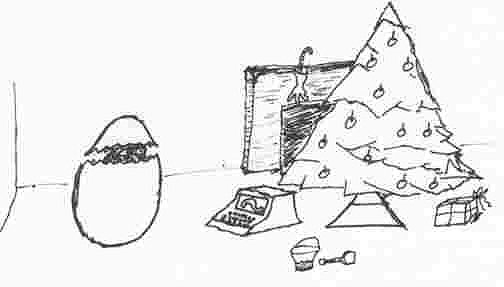
MILD SURPRISE (Fiction)
It had been a good night until then. Place full. Flavius the Centurion had to be called to get his soldiers in order. He was over there giving them a chewing out. I had to put a couple rebels out the door in a big hurry when the wine got them talking too much. Had to toss out a couple shepherds who were getting too fresh with Ruth, who's older than they but still a child. Swatted Ruth herself twice for no good reason. Shouted at Bildad, Ruth's brother, thee times for being slow, since he obviously couldn't keep up with the work and people had to be reminded. Managed to get my worst mug into the hands of the tax collector while he was in the middle of a story, so he didn't notice until it fell apart, wine and all. Then it was too late and he paid for the wine and the mug both. Got them sleeping five in a bed upstairs. Altogether a very good night.
I had propped my belly on the counter and was trying to decide with things this busy if I couldn't help myself to another skin of wine or should I just go on overeating when he comes in and asks for a room. His wife's going to have a baby.
"Baby!" I exploded. "This ain't no place for a baby. Look, I got drifters, I got shepherds, I got tax collectors, I got rebels, I got Roman soldiers. I ain't got no place, for a baby. Here. Look at my register!"
Instead he looked me in the eye. Medium frame. Clear eyes. Eyes probably gentle most of the time, but not right now. Hands of a carpenter. The kind of ingrained coarseness that comes of planing wood until its right, and then going on to plane out the stains left by his own sweat and the prints of his own fingers in order to have the finished wood above reproach. Pride was there, too. He held his head as if he were a direct descendant of King David. Not at all the kind of person you want to tangle with.
"Can you make room?"
Part of my head starts to do some numbers. Suppose she has her baby tonight. Then she'll need to be confined for, O, eight days or two weeks, depending. And that will tie up a room and cost me about ... but it doesn't make any difference. I don't have room for Herod. So I say, "Even if I did, you'd be better off in a barn."
That's when she comes in. Suddenly the sound of the crowd is very far away. She's a beauty all right, and expecting. But there's something else about her, too. She comes up softly and stands by him. Asks if there's a problem. He waves at the register, which I've turned around upside down so it's right for them. Her eyes dance over the lines. That's it. She's a reader.
"He's already given up his own bed," she says. I feel my ears turning pink. "There really isn't any room, is there?"
I try to think. "It wouldn't be all that bad, really. A barn's a clean place." It shouldn't be bad. The swept floor, the breath of the animals. The moldy smell of stored hay. The warmth. The cold fresh air from the outside.
"Trust me." That's not my strongest line. But she took him by the hand.
His attention was divided a moment between me and speaking to her, "Where?" That's why he ran squarely into Flavius, who was dragging one of his men out by the scruff of the neck.
While the men got untangled, she said, "To the barn. He said to trust him."
I took a long drink of good well water. "Bildad. Take a break!"
It must be about a week later when Flavius comes back. He marches up to the counter and stands very straight. "Have you had any babies born in this inn?"
I say, "No, b...." There is something wrong in his voice. It sounds like sawing nails. I look at his eyes. The pupils are pinpoints. His eyes are those of a man who will either vomit or become unbelievably violent if pushed any farther. I know Flavius. He isn't the vomiting sort. "No baby. Why?"
He has an armed legionnaire at each haunch. Their mood looks ugly, too. There are other Roman soldiers around the room within earshot.
"Herod has offered a reward for anyone who can locate a certain baby." He takes out a purse and places it on the counter. I undo the string and out pours gold.
"I like gold." I pick up a coin. Under the oil light, it is a deep yellow. A coin of solid gold. A year of running the inn. A year of life. The coin spells rest. The coin spells freedom. The coin spells things I will never see. I take out another and then another.
There are thirty of them. I couldn't live thirty more years if I tried. Thirty years. A lifetime. "Do you have the baby?" The voice of the centurion sounds strange, but I am looking at the gold. Something is wrong. Thirty pieces.
Then I realize it. Thirty is a round number. Flavius did not take any himself. Unless there had been fifty to start with, and even a centurion would hardly steal twenty gold pieces from Herod. But why not a piece or two? No one need know. But he has not touched the king's gold.
There was only one explanation. Herod, for whatever reason, meant to destroy the child. And Flavius was heart sick and furious. Doesn't he remember that night? Of course he remembers the night. He was almost trampled in the doorway. And he knows I remember, too.
"Baby," I exploded. "This ain't no place for a baby. Look, I got drifters, I got shepherds, I got tax collectors, I got rebels, I got Roman soldiers. I ain't got no place for a baby. Here. Look at my register."
I turned it around for him to read.
He reached out a muscular arm and took the whole register. "I think I'll do just that."
There was a pause. I was supposed to say something. Suddenly I remembered what it was. "Hey, you can't just take my register and walk out of here! That register records every guest for the past seven years!" Of course he had to. Flavius wouldn't be able to read it himself.
"O yes I can. Men!" His two guards shouldered their way around him as if to protect him. As if I were going to throw my huge bulk across the counter and do battle for my book. Flavius withdrew under their cover. But his eyes no longer looked like you could strike sparks off them with iron.
I shout for Ruth. She comes.
"Go out to the stable, Ruth, and tell them eight days are up. Tell them I'm sure. My register says so. And tell them to get their donkey moving toward Egypt. This isn't the end of it."
M