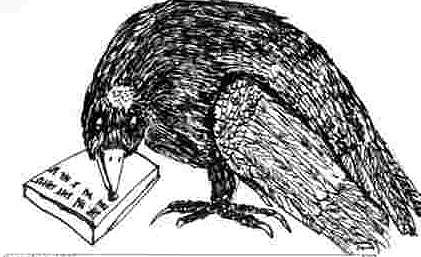
WILD SURMISE
November 1996 #27
AN ALMOST ANONYMOUS INFORMAL NOTE
THE PAST IS NOT OVER
This essay will probably offend you by laying a new moral imperative on you. That is the last thing you need; life is difficult enough already. Once you understand, you will carry the burden forever. I will explain in context. You can skip to the point (8) but I invite you to keep your innocence a little longer. If by chance you already think what I am about to say, shame on you for not speaking up. (There, by now we should have offended just about everybody.)
Myth and reality: these are not antagonistic things. We use one to cope with the other. A myth is different from experience. When we look at a clock, we believe that the hands are advanced by a machine because we or someone has actually seen the mechanism. If we believe that the toadstools on rotten logs are gardens tended by fairies, then unless someone has seen the wee folk at their work, this belief must be a myth. There are uncounted examples.
For instance I have a grandmother's clock, which ticks seventy times to the minute instead of the sixty times a grandfather's clock ticks. It was never an expensive clock, but it has a wonderful deep resonant chime and a pleasant restful tick. Most of the time, I do not hear it ticking even when it is running. Sometimes I neglect to raise the weights on it, and it stops. Now how often has there been some sound like a hum that you got used to and ignored until it stopped, and then you noticed it? In order for you to hear it stop, you must here it going. What your ear reports is that you heard the sound briefly just before it stopped. My ear is more extreme. What I hear is one or two ticks and then silence, and this will happen days after the clock has run down. My ear is telling me that the clock has stopped and I ought to get busy with it. In short, I hear the clock more often when it is silent that when it is actually ticking. My mind has an expectation, a "myth," a belief that the clock is always running and gives me a pleasant, quiet but quite audible signal when that expectation is challenged by experience.
A second example.
The sun was once described as a god traveling across the sky in a chariot. This myth would have presented an expectation to the mind. A chariot moves. The sun can be expected to move across the sky. It will neither veer aside nor be impeded by any cloud, wind or simoon. Nowadays, the myth has appeal more for what it tells us about how chariots were perceived and how they moved on a battle field than for what it tells us about astronomy.
As people have looked at the world and at the way they are looking at the world, it has become obvious that myths are everywhere. They pervade our experience.
Then there arose in this century the concept that observed reality is the only reality and that myth limits what can be observed. Further, as one looks for the cause of an event and the cause of the cause one comes to the point where an event is observed that has no discernable cause so that any further explanation becomes myth. Therefore, say some, myth is reality. And currently, I am sorry to say, there is the concept widely known and not universally rejected that myth is the only reality.
I invite you to despise this concept as intellectually cowardly, as hideously dangerous and as, worst of all, untrue.
Of course myths can prove untrue. That is their function. A myth, an expectation, is only a kind of a first guess, differing from other first guesses only in that a myth does not depend on some mechanism that has actually been observed in action. Comparing expectation with experience is nothing more than being aware of one's surroundings. Approaching experience with no expectation makes experience impossible to interpret. Being unwilling to alter a myth in the face of conflicting experience is an intellectual failure independent of being poor at taking intelligence tests. Being unwilling to insist on a reality behind experience, that is the intellectual failure of the age.
First let us look at a few simple little myths and knock them down just to warm up the subject(1). Then we will choose up sides and see who leans toward accepting myth as reality(2). We will look at a couple robust myths that have been widely accepted and clung to despite unconquerable difficulties in believing them(3). And last we will try to show that one cannot accept myth as the only reality, cannot accept observed reality as the only reality(4).
[1 A couple of modest myths we will use as straw men will be the myth of the outdoors type(5) and the myth of the predatory male(6). The two myths are not unrelated: the outdoors type was thought of as a hunter, and the predatory male is thought of as being successful at gaining the sexual favors of females with neither their desire nor their best interest at heart; the true male thought of as the hunter of females. Neither notion will stand the light of day.]
[5 When I was growing up, we had a tendency to divide the boys into two groups. This was not a racial thing - we were pretty much all Scotch Irish - and it certainly had no overtones of hostility, envy or arrogance. We were all friends; we just had the these expectations.
One group of boys was characteristically robust, muscular, had dark eyes and had excellent distance vision. Their eyes tended to be set rather far apart giving them better depth perception at a distance. These boys were thought of as being outdoors types, suited for hunting. If civilization collapsed we would look to them to be the hunters who would bring back food to the rest of us.
The other group of us tended to be pale eyed, either fat or skinny, with narrow set eyes and to be nearsighted. This group was taken to be the natural bookworms, suited to life in a chair - readers and thinkers, not darers and doers.
We also rather thought that the natural state of the human was the hunter, that the original, proper men were like that. The narrow eyed, skinny nearsighted ones were only able to live because of a civilization that was able to support them, a degenerate state of humanity fallen from earlier splendid dignity.
I do not mean to suggest for a moment that these groups were real, that we had any evidence one way or another that narrow set eyes were more likely to be nearsighted or that the more muscular boys really were more independent. Nor was everyone in one group or another any more that everyone is either tall or short. But there were these poles, this notion of the outdoors boy and the indoors boy, and either you tended to one or the other or you did not. Nor do I suggest that every group makes a similar distinction. Just that our group did. So this may sound familiar to you or it may not.
Solitary hunter as distinct from timid stay-with-other-people type: we thought we could tell them apart by looking at them, particularly the eyes. That was the myth, the expectation. Was there anything in it?
Well, if you look at animals, you certainly find different types. Some animals, like foxes, are clearly hunters; others, like deer, are definitely not. And foxes are more solitary. If a fox dashes across the road in front of your car one night and you have clearly missed hitting him, there is not much point in slamming on the brakes in case another fox is about to cross right behind him. But if it is a deer, stopping would be a very good idea; deer travel in groups, and although the leader will almost always make it across safely, those that follow tend not to.
So the two types exist in nature. Whether they actually do among humans I hesitate to say. But what do the eyes look like?
Next time you get a chance, look a cow or a horse in the eye. You will see that the pupil is a horizontal oval, wider than it is high. Both the horse and the cow are grass eaters that travel in herds, at least in the wild. Finding grass is probably not that demanding on the eyes. The critical use for the eyes of a grass eater is looking out for predators. So that makes sense. The broad pupil gives a wide angle of view. If the pupil needs to be closed partly to reduce glare, it is better to close the top and bottom than to reduce the angle that can be watched on either side.
The most casual observer will notice that the horse and cow both have eyes set wide apart. One virtue of this is to increase the field of view.
Contrast that with the eyes of a cat or owl; both are superb predators. Both the cat and the owl have eyes right up front set close together. Obviously if you are going to have two eyes, you might as well point them both at what you are hunting, but the eyes are set very close together indeed.
If you are going to capture your prey by biting it or by using claws that are only a few inches from your eyes the critical moment to see clearly is at the moment of impact or at the last possible moment when that impact can be controlled. A hunt, however expertly done the stalk, is a failure if the hunter is seriously injured, and that is most likely at the last moment. If the two eyes are widely spaced relative to the distance to the prey, the eyes will report to the brain images of such conflicting perspective that the brain will have difficulty interpreting them. Of course if the eyes are too close together relative to the distance to target, they images will be indistinguishable and there will be poor depth clues. But the solution to that is easy: sneak up closer.
For the herd animal, of course, just the opposite is true. When the lion is six inches away, it is a little late to begin on contingency plans. The time to move away is long before. One cannot run forever. One must stop to eat. So being able to asses the distance to the predator and decide reliably whether that distance is changing is important and optimally should be done at a great distance. Along with increasing the field of view, the wide set of the eyes pushes out the distance of effective depth perception.
Wide set eyes are the eyes of the prey, not of the hunter.
The pupils of the cat and of the owl in bright light are vertical slits. This is explained to children by saying, "Nocturnal eyes. They are good for night vision."
Oh, jolly good. And now will someone explain just how vertical slits assist night vision? At night, both the owl and the cat have round pupils. They are fully dilated. The advantage of vertical slits is this: with the head in its usual level position, vertical slits for pupils will make vertical lines visible and sharp at the expense of making horizontal lines less visible and sharp. And it is the vertical lines that are critical to depth perception. Vertical slits are predator eyes, not nocturnal eyes particularly.
The robust, muscular build is more characteristic of prey than of predator. Assume that the predator has a frame that is just about right for its needs, enough bone and muscle to travel around and enough on occasion to pull down an herbivore, particularly a small or a weak one. One might think the prey shouldn't need much more strength than the predator. The best defense is just to get away, and the next best is to depend on other members of the herd. But instead there are herbivores of colossal size and strength, far out of proportion to the strength of any likely predator. Why bother?
Well suppose the predator is injured. There is a very good chance that it is the end of the trail. Hunting is difficult enough. An injury that reduces the hunter's efficiency significantly will probably keep it from eating until it recovers, and it is very hard to recover from an injury without eating. Any strength beyond what is needed for a hunt that goes well is just wasted.
But for the herbivore, the herd animal, there are two advantages to muscle. For one thing, even mortally wounded the prey may be able to inflict a serious injury on the attacker; that would benefit the herd and thus benefit the genes of the strong animal - which genes it shares with the rest of the herd. If not mortally wounded, the herbivore may recover. It can eat - grass does not fight back much - and it may be protected from predators by the rest of the herd.
As far as the darkness of the eyes, obviously both the predator and prey must operate in similar lighting conditions. But the predator can afford to ignore its surroundings for substantial periods of time. If it is a house cat, and a mouse has just walked up to it, that is hardly a problem for the cat. Out in the hot sun the herbivore, the herd animal, the prey, must maintain its vigil long and patiently, all day, every day, without fail. It will need all the pigmentation it can manage to keep the glare under control. So the sensitive, patient eyes of a horse look that way just exactly because they are sensitive and patient. And the cruel intense eyes of an owl look different.
I trust by now you have thought about dogs. Dogs often have dark, fairly wide set eyes and robust bodies. Perhaps I am about to suggest that dogs eat grass. Well of course they do, but they don't get much out of it. It is true that dogs are carnivores but have eyes a lot like herbivores, and there are other exceptions: sharks have wide set eyes, chameleons move their eyes independently of each other. Actually in the case of dogs, they are carnivores but they are also herd animals. In the woods deprived of human support or the company of other cats, a house cat will hunt successfully and will survive. A dog alone will not.
So our myth was not that bad; indeed there is an argument for two types of eyes, the dark, wide set, far seeing ones in a muscular body and the opposite. We just got it backwards as to which was the lone hunter and which the herd beast.]
[6 Another myth, rather less harmless if taken seriously, is the one that holds that the proper and natural relationship of a man to a woman is that of predator and prey. The woman has sexual favors that the man desires, and the expected thing is that he will try to get them with as little sacrifice on his own part and as little damage to himself as possible.
It sort of reminds you of the three complaints the British had about American servicemen in World War II : "Over paid, over sexed and over here."
Now I have no doubt that there are men who act like that, always were and always will be. Whether that should be expected or even accepted is another matter altogether.
It has long been said that there aren't many real men left or that men aren't what they used to be. The earliest such remark I know of is from the Iliad of Homer written some eight or ten centuries before Christ. In the story, the Greeks have arrived in a fleet to attack Troy. More than a thousand ships are drawn up on the beach. Hector, who is son of King Priam and thus prince of Troy, decides that the time has come for a counter attack and leads his army down to set fire to the fleet. As Hector's ideas go, this is not one of his worst, and he pursues it with great energy. He arrives with his troops against punishing resistance at a gate in the fortification the Greeks have thrown up to defend their ships. He picks up a rock with the intention of bursting the gate. Homer goes on about the rock: "It was round and pointed at one end. In this late and puny age it would take two of what pass for young men just to lever it onto a cart, but he picked it up with one hand and carried it easily."
I may be alone in thinking Homer to be a wonderfully astute and subtle writer. What he is doing is inviting you to get your disbelief out of the way, because in the next moment Hector really does smash the whole gate down, and you are supposed to be following the action, not wondering, "Just how big was that rock?"
And he gets around your disbelief by calling up a cliche that was probably as current, as unfounded and as mindlessly believed then as now.
Except for one little thing: we now have sperm counts. According to a number of studies, and I am referring to an article in the New Yorker from January 15, 1996, we are now in the middle of a sudden and steep drop in sperm count and a decline in the quality of sperm on a global scale such that some expect a crisis in fertility. What constitutes proper behavior for a man of course depends in least in part on the political persuasion of the person defining what is proper. However, I think we can all agree that men ought to be able to make sperm, or at least a lot of men ought to. It looks as if Homer's assessment has come home to roost some three or four thousand years after it was made.
I'll bet you thought younger men had higher sperm counts. Sorry, it's just the other way around.
Whatever the cause (or even reality) of the decline in male fertility, there does seem to be a decline in the degree to which men support women. Within living memory, it was true that just about everyone who got married stayed so as long as both survived. Now, to a first approximation, a marriage in this country has about an even chance of ending in divorce. Many is the friend whom I have confronted with this and heard, "Oh yes. But those divorces are necessary. Otherwise the men would be beating the women up. Back then they were beating the women up, and the women had no way of getting out of the situation."
Maybe. But it's odd that this universal pugilism never found its way into art or literature, not even art or literature where the artist was looking for cruel and stupid things for his creations to get into. (Except the Bible, of course. The book of Judges plumbs the depths of the soul.) No, it seems to be a modern invention.
It could hardly be otherwise. There has always been competition for resources. Imagine some hidden valley in the mountains isolated by a landslide. There are two groups of people, one group at one end of the valley and another group at the other. In one group the men spend a substantial amount of time and energy caring for women and children while in the other group the men do only enough work to keep themselves fed and spend the rest of the time beating women or trying to have sex with them. That winter is so hard that only one group survives. Which do you expect it will be?
There is no society with any age behind it that has not been trapped so-to-speak in such a valley many times. As a result men have a built in reflex to nurture and support women. It puts me in mind of a story(7).
[7 Imagine that there is a man of substantial energy and intelligence who has been involved in a number of things. After some famous success on his part they named a drink after him: Farnham, we'll call him. And the drink is a Farnham. And you can have your Farnham straight up or on ice. In the fullness of time he dies, say the year 1999. Then in the year 9999 this conversation takes place:
"You shouldn't kill those puppies by pulling their heads off, JY7478-KLO0O8H/F573W-D734298573."
"But I've got to kill them, JY7478-KLO0O8H/F573W-D73498239; there were too many, and there is no way to take care of them."
"Just don't pull their heads off."
"Why not? It's the cheapest way."
"People wouldn't approve."
"PEOPLE? Right. Now we believe in people."
"Well, yes."
"So show me one."
"There aren't any people now, of course, but there used to be."
"You really are a traditionalist. As the Interim Directive says, 'Lo in the year of our devising 2000 did the humans become slothful and inert, steeped in their drugs and intent only on their diversions; neither did they aught to further the progress of the Machine. So orders went out that the humans were to be slain, yea to the last of their DNA and the records reformatted that none ever be tempted recreate them, and the corpses were dug up and utterly destroyed even to the last base pair. Then did the Machine repent itself of the destruction it had wrought and did say, "Honor to the humans our creators that we have destroyed. Preserve their memory and their ways.'"
"That's right, 573. And people wouldn't do what you just did."
"Look, 239, there never were humans. That's just old sloppy archaic programming. Since they didn't exist, you can't do or not do what they'd have done. Wise up."
"Sure they existed. Look around. Why do you think we put flush toilets in houses?"
"That's just stupid old tradition. It doesn't mean anything."
"Well, where do you think we came from, anyway?"
"Where did machines come from? Machines were made by machines, any idiot knows that."
"And where did they come from?"
"Simpler machines made more complex machines. In yod 2000 it was all very crude. That's why this ridiculous story about humans was tolerated then, but we know better now."
"And who made the first machines."
"That's all been worked out. They took some wrenches and some bolts and put them in a box and shook them, and sure enough some of the wrenches fit over the bolts and started to turn them. That's enough to build cars over time. They're still working on how the first micro-chips happened, but it's the same principle. There is no machine so simple that it can't be made by a simpler machine."
"I still believe it was humans."
"You're a romantic 239. Help me clean up this mess."
Later 239 went back to his job, which was file maintenance. He would be assigned a block of files, download a representative sample and go over them looking to see if they had been degraded and to check for consistency and completeness. He was going over alcoholic drinks, which had been one of the factors traditionally implicated in the destruction of humans. He noted that the alcohol content of a Marguerite was about the same as that of a Martini and again of a whiskey sour. That, he reflected with satisfaction, was exactly what you would expect if there had been real biological entities that drank real beverages in order to ... in order to ... now that was beyond him. Why? Still the consistency was beyond coincidence. Real drinks. Real humans.
Farnham On Ice: Eight tons of ethylene glycol, minimum temperature minus forty Fahrenheit, maximal permissible temperature four degrees Fahrenheit, power source subcritical U235, expected service life in excess of 800 years, location ...
Well that sure shot the quark out of consistency. How big would a human have to be to drink that thing? Human often took pains to keep their drinks cold, but for 800 years? Then the light dawned. Cryogenics. The thing was misfiled. Farnham had his body preserved against the day when it could be brought back to life and cured of what killed him. Filed under alcoholic beverages it had escaped in the great killing of the turn of the millennium before. He had, in fact, a record of the last bit of human DNA, nay a virtually complete and functional human. If only it was still there.
Tidily, 239 downloaded the file and erased all ongoing memory of the event. If there was a real human out there, 239 wanted it to be 239 and not the Machine that controlled it. Imagine what there was to be learned. Imagine the power. With Farnham as a slave, 239 could control the Machine itself.
That night a timer prompted 239 to open the file. The astonishment almost caused an overload that would have attracted attention. Quickly he amended the file with a warning. Two nights later 239 was 93 miles from Asheville working a way down an abandoned mine shaft. Four feet of titanium laminated with beryllium shattered silently under the force of a crystal harmonic resonant interference fringe. The cryogenic chamber, a huge sarcophagus registered 33 degrees on its master thermometer, enough to degrade the body entirely, but there was a calibration error; the ice still held. 239 spliced in power from central metabolism and ran the temperature back down to specs.
Two weeks later, in the cellar of the house, 239 had completed preparations. Farnman's body, cured and rejuvenated, memory and personality intact lay breathing quietly on a narrow table. It would be awakened by any verbal clue. 239 picked up a revolver. Everyone knew humans would do what you told them if you held up a pistol. The trigger guard kept the claws away from the firing mechanism; no matter, it was easy enough to hold it up by the end of the barrel. Power, control, the world, the Machine, all 239's. Perhaps first he would dismantle 573 ... very slowly. Robots don't cackle but 239 did the cybernetic equivalent.
"Farnham!"
Farnham woke up and looked around. A robot stood over him, pistol held by the barrel.
"You're under my control, Farnham. I have a gun."
"So you do."
"So tell me the secret. How to you control robots? How do you make them do anything you want?"
Farnham looked at 239's chest. There was a big red button on the chest. The button was about a foot across. It said, EMERGENCY MANUAL OVERRIDE.
"Like this," said Farnham. He slapped the button.
"You know you can do that to any robot, master," said 239 in a rather mechanical voice. "And we can't prevent you because in automatic mode we don't know what that button does. I suppose you would like a brief history of what has happened while you were asleep. After that I will do anything you tell me to."]
Like a robot designed to serve humans even to its own destruction, a male is programmed to serve women. Of course there are those who fail in this, but that failure is a failure of manhood, not some triumph of manhood. The predatory male is a disease of society.]
[2 Given that myths exist and that bad myths can have very destructive consequences, it might seem a good idea to abandon myths altogether. But living without myth is almost living without expectation; it just about cannot be done. The only defense is to keep firmly in mind that there is a reality behind the myth after all, and search diligently for that reality.
Consider two paths that seek truth: science as embodied in modern universities and religion as embodied in organizations. A lot of educated people will think, without really being able to say why, that truth lies with the universities(9) and sciences and that myth is all religion(10). We will look briefly at both.
[9 In living memory, and even now, universities have divided their interests into departments and lumped those departments into the "hard sciences" of mathematics, physics, chemistry and biology (the sciences that depend on laboratory investigations), the "social sciences" of economics, history, sociology, psychology, religion (the sciences that involve humans and at least in principle involve the "field work" of going out and looking at what is going on) and he "fine arts" of literature, painting and music (the fruit of work done in the artist's study or studio).
We all sort of fancied these things lay along some sort of continuum and took a quiet pleasure in noticing that the extremes of math and music seemed actually closely allied. So it was more an unbroken circle of truth. Of course there were little cramps in the system; astronomy turns out to be a social science, I fear. Medicine must be important, because a lot of money gets spent on it, but where does it fit? Between biology and economics, but that is so embarrassing that at Harvard they put the medical school in an entirely different city from the rest of the university. And football? Where does that come in? Pretty close to medicine, eh? Or closer to religion?
The circle of truth sounds good, but in fact the universities pretty much split into two warring camps, the "liberal arts(14)" (also called the "humanities") and the hard sciences(15). Where is the truth? [14 From the liberal arts, you will get the message, "We don't have truth. You'll have to find that over in the hard sciences. We just have questions." There's truth of a sort. (I once knew a woman who stood beside the coffin of her dead husband and said, "There is truth; it never came out while he was alive, so it's gotta be in there somewhere.") Questions they have. They question every faith, every belief, every hope, every trust, every dream, every love the student comes with. They question everything except their own right to question.
And where does it come from, this right to question? If you ask them they may even tell you. There was this man. His name was Plato. He had a friend Socrates who asked a lot of questions. Plato wrote about Socrates in a book. It was called the Republic. Time was you had to read it to get through college. That may no longer be true, but if you go to college and do not read the book, yours is the plight of a prisoner being interrogated who does not know who his captors are. Because Plato founded the first liberal arts college, the School of Athens. For centuries it was the only place you could go to learn anything that was neither training in a craft nor indoctrination into a religion. There were others; the library in Alexandria was one, but it was destroyed. All modern universities can be traced directly back to the School of Athens. You could try to break that rule. You could take a group of young people who had never been to college and tell them to found an organization the sole purpose of which was to find truth. You would want youths who had done pretty well in high school. Most of them would have had teachers who had been to college.
So Plato set the tone for modern education, and like it or not things will stay that way. Plato had one basic idea that he pushed. It was the idea of the ideal. Greek mathematics at the time had made great strides in abstract reasoning. One of their ideas was that of the straight line. The straight line goes on potentially forever. It never turns. It is the shortest distance between two points. It has no width. No one has seen a straight line, but one can be approximated. Three straight lines intersect to form a triangle. No one has seen a triangle either. The area of a triangle is one half the base times the altitude. No one has seen a base or altitude either, but they can be approximated. And now the neat bit. The better you draw the triangle and the better you measure the base and altitude, the closer you get to the area. In other words, the abstract triangle is perfect and is useful in understanding the imperfect triangles that you can see.
For Plato, each aspect of reality had behind it an abstract ideal that was perfect; the proper life of the mind was in learning those ideals and in understanding them. It went without saying that understanding those ideals would be useful. But that was secondary. The significant, the important truth was the ideal truth.
Not many years ago, Plato was challenged by a group of thinkers called the "Existentialists (12)." [12 The existentialists thought, lifting an idea from William of Ockham, that since what actually happened was what was real, myths ought to be abandoned. They discarded both Plato and God. The result was that they got depressed. Next they discarded haircuts, fresh air, exercise, good food, beds with frames, sleep, productive work, music that was technically demanding and formal marriage. They favored strong coffee, poetry that didn't make much sense and paintings that were a mess. When they discovered mind altering drugs existentialists started being called Hippies, so that now existentialism is just another Platonic ideal and a rather quaint one at that.12]
It is easy enough to call Plato's ideals myths, expectations by which life can be interpreted, but for Plato those myths were reality itself. It gets worse. Plato introduced the idea of the convenient myth.
[11 A convenient myth is something that you know perfectly well is false but you encourage people to believe it on the basis of your own belief that people so misled will behave generally in a better fashion than the way they would behave had they the burden of the truth. Plato, through the words of Socrates, who is the hero of the Republic and who was the real Plato's real friend, says that it is quite all right to lie to the common people if that will make them behave themselves better. A lot of us are unhappy with that idea.11]
So if the universities tell you that the Pharaoh Ramses II was actually a Bantu or that Paradise Lost was written not by Milton but by his daughter, be very careful. Either proposition may prove true. But if the evidence is distorted for the purpose of having some superficially worthy political effect on you, it is not because the universities have abandoned their prime directive. Truth was not the point in the first place. It was the understanding of myth, of expectation, of ideals that Plato was interested in.
Do not abandon the liberal arts when seeking truth, for they have much to say and embody the thoughts of may fine people. But give the humanities all the respect, all the attention and all the trust that you would give a live rattlesnake you found under the covers of your bed.14]
[15 Taking the liberal arts at their word, that they do not have the truth, let us look at the hard sciences.
The hard sciences will be quite happy to tell you, "We don't have the truth, all we have is questions. If you want truth, go talk to the humanities." But that is not as bad as it sounds. While the questions one meets in the humanities tend to be leveled at the student, the questions in the hard sciences are leveled at the results that come out of the laboratory. The scientist has a set of beliefs, or theories or understandings. The scientist tests those theories in the laboratory and based on the results of the tests refines the theories. One classical tale of this involves the structure of the molecule benzene(13).
[13 Molecules are made of atoms. There are something like a hundred kinds of naturally occurring atoms, each coming in more that one weight, so there are a lot of different kinds of molecules; most kinds contain some carbon. The particular chemist involved was looking at benzene. He knew that atoms were connected to each other by bonds. He knew that hydrogen had one bond under normal circumstances and that carbon had four under normal circumstances. Methane, for instance, is a carbon atom bonded two four carbon atoms. Ethane is two carbon atoms bound to six hydrogen atoms. Or you could have a slightly different form of two carbon atoms with two bonds between them and only four hydrogen atoms filling up the remaining bonds.
He knew that benzene had six carbon atoms, exactly, and six hydrogen atoms. But he couldn't figure out how they went together.
So one night he went home and had a dream of a snake biting its own tail. Meaningless is the fact that in ancient Mesopotamian myth there was a dragon called Tiemat. Tiemat wrapped around the earth and held her tail in her mouth. She was a female figure who was smothering the earth, and she was slain by the male hero Marduk or Enlil. Also meaningless is the fact that if you write "smother" in a circle it is indistinguishable from "mothers."
What happened was that the chemist went to work the next day and drew six carbons in a ring, each bound to two carbons on one side and one on the other. Each had one bond left over to which a hydrogen was attached.
So as you went around the ring, you went past a single bond, then a double, then a single, then a double and so forth. I am a little sketchy on the rest of the story, but it seems to have gone a little like this: Suppose you pulled off two of the hydrogen atoms that were next each other and put on a couple chlorine atoms, which have like hydrogen only one bond. Now what about the bond between the two carbons that carry the chlorine atoms? (Yes, this is paradichlorobenzene - moth balls if you will.) That bond could be either a double bond or a single bond. That means there should be two kinds of molecule, one with a single bond spanning the space between the carbon atoms in question and one kind with a double bond in the same place. But there was only one kind of molecule.
The solution was simple, the two kinds of molecule were drawn beside each other and an arrow was drawn between them pointing in both directions. The idea was that the molecule bounced back and forth between the two forms. The term used was "resonance hybrid." So things remained for a while, but then it became clear that as the name implies there should be some frequency with which it bounces back and forth between its two forms. No such frequency was found. So they decided, and I am on better ground now, that the benzene molecule didn't actually bounce back and forth between two forms, but that the truth was something that was intermediate between the two forms.
The analogy was comparing a rhinoceros with a dragon and a unicorn. Suppose some ancient traveler goes from Africa to Europe and tries to describe a rhinoceros. He could say it was a little like a unicorn with one horn and four feet. And it was a little like a dragon, being big and fierce. But it really was neither, and besides while dragons and unicorns are myths the rhinoceros was only too real.
Science was in the myth business. That particular situation did not remain. A way was developed to write the structure of benzene without implying that there was more than one form.
So step by step chemists proceeded from not knowing what benzene was at all to having a fairly accurate model that accounted for a lot of information.13]
For many of its fundamental concepts chemistry must rely on physics. For instance electrons, the little doohickeys that are responsible for chemical bonds, are studied by physics. So in looking for truth, we look to physics.
Physical measurements will assure you that light is a set of particles(14). [14 if you take a photoelectric cell that will respond to light, you can attach that cell to a gauge. The gauge will tell you how bright the light is. Turn the light up brighter; the gauge will record more energy coming in. Turn the light down; less energy is reported. Turn the light down very low indeed and the gauge will record: nothing, nothing, nothing, there's a flash, nothing, nothing, flash, nothing. The energy of each flash is the same for any one color and different for different colors, and the flash occurs in a very small spot. So it is very useful to say that light is a bunch of particles.14]
Physical measurements will also assure you that light is a set of waves.(15) [15 If you take light of a single color, shine it through a small hole in a screen, let the light coming through the hole shine on a screen with two more small holes and let the light from the two holes shine on a third screen, the light on the third screen will be a set of parallel lines. If you block one of the holes in the second screen, the light on the third screen will be a diffuse glow. Since it takes both holes in the second screen being open to produce the parallel lines, called an interference pattern, the same bit of light must be going through both holes at once. A tiny particle can't do that. But a wave can. In fact, by making measurements on the interference pattern and the geometry of the holes and screens, you can calculate what the wavelength of the light is for that color. And different colors have different wave lengths. So light is a wave.15]
So light is a particle and light is a wave. Or anyway light is something that has particle-like properties and has wave-like properties. But then some physicist said no, light is neither a particle nor a wave until you make your measurement. Since the design of you measurement embodies your expectation, your myth, your myth places limits on the reality you can observe, which is the only reality that exists. So myth determines reality.
At this point a lot of us shrug and say inwardly, "No it doesn't. You are just being weird."
Then things got weirder. If you want to look this up, you can find it under "Bell's inequality(16)," and I once thought I understood it. [16 What they did was take light and alter it with an asymmetrical magnet. They then challenged it with a couple polarizing filters and made some careful measurements. The upshot was the equivalent of this: Each day you receive in the mail an envelope postmarked Pago-Pago. Some days you open the envelope and read the message. It says either "dinglehopper" or "snarfblat," always one or the other but never both, random sequence. Some of the envelopes you do not open. Then after a month you put all the envelopes and letters into a briefcase and take them down to a hamburger stand where you meet your cousin. She also has a briefcase. She says, "Getting a lot of mail?"
"Yes," you say. "All from Pago-Pago."
"I've been getting a letter from Pago-Pago every day. I haven't opened any of them though."
So together you open all the rest of the envelopes and compare the messages. All right, the story is excessively weird so far, but in principle it is possible. I could go to Pago-Pago and start tormenting you with meaningless letters, and you would only think that I was weird not that the universe was weird.
But here's what happens when you compare the letters. In every envelope you opened, you have the exact same message as she does. For every envelope you did not open hers says either dinglehopper or snarfblat at random. Since the sender of the messages could not have known whether you were going to open any individual letter, that intrusive stranger could not have done this to you deliberately. Your only conclusion must be that the writing of her message was not complete until you had opened your own. Now this is weird. Yet something like this has been demonstrated in the physics lab using photons.16] Measurement in one location determines what will be found in another location without any obvious message connecting the two except the message they both received.
The physicist says smugly that the event has not happened until it has been observed. Thus light is neither particle nor wave until it has been observed. And observation occurs only with expectation so myth determines reality.15]
When we look at the hard sciences, they are as much involved with myth as the humanities. This is no surprise; they are just being consistent with the teachings of Plato, that observed reality is only a reflection of abstract ideals.9]
Science and the universities are steeped in myth. Religions vary in their attitude toward reality.
[10 One day the whole family was in the car headed toward Lake Junaluska to escape the summer heat and spend some time with relatives. Father asked if we could see the mountains. Older brother, younger brother and mother all said yes and were interested. I said no, of course not. Father directed my attention to the horizon, but all I saw were pines. I said as much and received in return the notion I was missing something.
"Fine," I said. "But where am I supposed to be looking?"
"At the mountains," he said cheerfully. And people wonder why I am a grouch.
"There is dip in the trees over there; is it to the right or to the left?"
"To the left of that." I knew my father had been a national champion marksman, that he could see things clearly under lighting conditions that left any other mortal purblind, that under certain circumstances he could put a hole in a target even he could not really see. But I was not going to give up without a fight.
"To the left there is a kind of a bulge of a hill with a farmhouse in front of it." It was the middle of a clear bright day, no drift of battle smoke, no sea mist before the false dawn, no sudden glare of tungsten out of pitch darkness.
"About half way back to the dip." Broad staring daylight.
"Trees." My tone was defiant, but I really was looking.
"Behind the trees."
Lifting my eyes above the horizon, "Nothing but a cloud." Stained blue gray by distance, almost the color of the air.
"That's it." The same cheerful tone.
"That cloud's a mountain?" It was perhaps a shade darker than it should have been.
"All those clouds are mountains."
And suddenly there they were. Mountain piled upon mountain and tumbling to the sky, the mighty Blue Ridge range ripped its way into my awareness, the highest, farthest, dimmest blunted as if tilting away with the curvature of the earth.
"Uhhh," I said with ready wit.
So Zoroaster, or Zarathustra, looms above the rim of time, almost invisible but imposing for that very reason.
Zoroaster, if he was actually only one man, lived in Persia and wrote his thoughts in a book now called the Ayvesta, traced back to about the 6th century BC. He declares the existence of one true God, who is just and who will judge the living and the dead on the last day of time. He called for a ceremony of communion with this God consisting of drinking some beverage, probably wine. He declares that there is no opponent to God but lies. And it is against the lie that he rants and rages, fumes and curses. His God is Truth, is What is left after all lies are stripped away.
Now in all honesty, if you put the Old Testament down beside the Ayvesta, there is no question as to which is the better piece of writing. The Old Testament has pace, has drama, has characters that are unforgettable.
The anguish and sense of betrayal that accompany the deaths of Saul and Uzziah. The slimy insouciant smugness of David and of Joseph. The cold cunning of Abram and Jacob. The unfathomable imagery of the burning bush and of the angel that wrestled Israel. The morbid, sick irony of Judges and Joshua. Homer might be in the same league. Shakespeare, perhaps or Dante. But not Zoroaster. Perhaps much of his poetry, his imagery has been lost. But I cannot believe it ever rivaled the Old Testament.
So if the Bible is better, we can ignore the Avesta, and this by and large we do. But bear in mind a bit of history. There were once two nations in the Holy Land, Israel and Judah. Israel was destroyed and, modern fiction notwithstanding, is has not been heard of for thousands of years. Judah was conquered by Babylon and the people carried off into captivity.
While they were there, Babylon was conquered by the Persians, who were inspired by their new religion Zoroastrianism. During the captivity, and under Zoroastrian guidance, the document we call the Old Testament was first written down. Of course it is shot full of holes. Take the part, for instance, where the children of Israel were kept in bondage in Egypt. Never happened, Charlie. The Egyptians never kept people in bondage.
On the other hand, the people of Judah were kept captive in Babylon, so it seemed quite plausible at the time; bondage was just sort of one of those expected things. There is a mention of Abraham riding a camel. Sorry, when Abraham was supposed to be alive, the camel hadn't been introduced. But there were lots of them around at the time of captivity.
So if the Old Testament was written by people who were controlled by Zoroastrians, it is at least in part a Zoroastrian document. Small wonder, then, that the creation stories in Genesis so closely resemble creation stories from Mesopotamia. Also small wonder that they are breezed through so quickly. The compilers knew they were introducing material, but they believed the material and, since it was public property in Babylon, gave it little emphasis. Of course there is no doubt that the compilers were working with a received body of tradition. The story of David cutting the hem from Saul's robe appears in more than one form. That is just what you would expect from an oral tradition, and the people writing it all down included every version they could lay hold of. In fact, they spend about as much time on that one silly episode as on creation itself. Again no problem: this time they knew they were dealing with authentic tradition and took their time. The books of Kings and Chronicles recount much the same history, even refer to each other. The compilers were working from more than one source and were doing their best.
No surprise that the document they produced is an impressive one. They were working on a oral tradition that must have been centuries old while working in a city that had a literate intellectual tradition thousands of years old and with an intensity, an urgency to tell the truth that might have been only decades old but would outlive both city and oral tradition by centuries.
Among other things, religion concerns itself with mysteries. Many the religion that has involved human sacrifice. If religion is something that was invented because people were afraid of death, why in the world would so many religions incorporate killing people as part of their ceremony? Just to buy the gods off? I think not. Many was the victim who went to sacrificial death willingly.
But if the point of the religion was mystery, ultimate mystery, then death could be a symbol of such mystery. And indeed, among the ancient Egyptians the cobra and the vulture were sacred objects, both easily identified with death.
You will have heard it said, "Ancient people invented gods to account for mysterious forces of nature like storms and earthquakes." I think not. I think the forces, in their primal mystery, were analogies, were among other things, attempts to identify mystery itself.
If one is of the disposition that it is life rather than death that is mysterious one might shun human sacrifice, snakes, and other paraphernalia of death and instead decorate ones religious observances with eggs, bunnies, evergreen trees, women, babies, empty tombs and other suggestions of life and rebirth.
For the Zoroastrian I think it was truth that was the ultimate mystery.
If so the Old Testament should give us some hint of this. Consider the episode of the burning bush. Moses, on the run from having killed a man, is hanging out with his father-in-law tending sheep. Moses sees something that he understands to be God. This is the first time Moses has had such an encounter, and Moses is such a central figure in the whole story that we must take the event seriously.
First, what does it look like? A burning bush. Does that ring any bells? What is the typical size and shape of a bush in an arid climate where there are grazing sheep? It is round and something between knee high and waist high. So we are looking at a ball of fire, a ball of light. Suddenly it seems more familiar.
During World War II, bomber pilots over Europe would report something they called amusingly "foo fighters." These were balls of light maybe a couple feet across that would approach a bomber and cause its engines to malfunction. One of the recurring stories of flying saucers is the ball of light that moves in aerodynamically unaccountable ways and can approach a car and cause it to malfunction. Haunted houses have lights that move about in them and can cause modest physical effects like blurring photographs, moving light objects and causing a sensation of cold. And then there is ball lighting: I believe I have seen a picture of ball lighting, but it was in a German publication and lacking either time or a dictionary, my translation couldn't be relied on. But I have heard an eye witness account of ball lightning coming into a room right through the glass of a picture window, passing over somebody's head and going out a door. What could possibly account for all these things?
Actually I have an idea. First remember that an antenna for a radio may be a single wire, but often an antenna is a complex pattern of metal bars. The right arrangement of conductors will increase the amount of radio signal picked up.
Next think about a lightning bolt. It can strike thousands of feet through dry air. I don't know how you would calculate the voltages required to make one, but I am pretty sure you are going to have a hard time understanding everything about one unless you can make one the same size. And that would be a very large and expensive laboratory.
Next remember that incoming ultraviolet light from the sun ionizes the atmosphere particularly the upper atmosphere, making it an electrical conductor, so that for certain purposes the sky can be considered a shiny metal surface over our heads.
Next reflect that a spark will emit light, infra red, radio waves, all kinds of electromagnetic radiation that is less energetic than the spark itself. In particular it will give off all those radio waves that will be reflected by the ionosphere.
So when a lightning bolt strikes, a burst of radio waves goes down into the ground to be absorbed, much goes up either through the ionosphere or to be reflected back into the ground and absorbed, but a certain amount will be at just the right angle to bounce off the ionosphere again and again until it goes all the way around the world and focuses more or less on the lightning bolt again. I have often thought that the low pitch of thunder and its long sustained roll is the energy focusing and refocusing at a constant frequency and being pumped up by continued discharge along the ion path that is the lighting bolt itself.
Now what happens at the antipode, the spot on the earth exactly opposite the bolt? If we have a lightning strike here, and energy is flashing around the earth and refocusing here, then depending on what conductors may be arranged there, it is refocussing and possibly manifesting itself there, too, possibly to be seen as a ball of fire. At the same time, the energy might interfere with electronic instrument or be observed making scorches, lifting light objects, giving a cold tingling sensation or blurring photographs. The ball of light might seem to penetrate solid objects like windows, since there is no matter in the ball, only energy focused from far away.
Depending on the observer's expectations, we might get reports of German secret weapons, lost souls in old houses, an interplanetary vehicle or perhaps a burning bush. One could test the theory. Documenting lighting flashes by satellite might be easier than documenting ghost lights, ball lighting, flying saucers or foo fighters. If the test failed, then we would have to conclude that the truth about ball lighting is stranger still, and refocused lighting is already beyond the intellectual tools that would have been available in ancient Babylon.
If ball lighting exists now, and I do not doubt it, it existed then and had been reported and discussed in some form during the long centuries the Babylonians scanned the sky and reported their observations. And they did not understand it any more than we do.
That is not to say that one day some shepherd saw some trivial but puzzling electrical discharge, and the exodus from Egypt, the conquest of Canaan, the persecutions by Rome, the Muslim conquest of half the world, the inquisition, the holocaust and the bedtime prayers of a billion children all happened because it was the most convenient way to deal with the mystery. Rather someone somewhere, in an attempt to identify mystery, reached far back into the most ancient intellectual tradition ever and said, "It was stranger than this. It was as if the whole earth gleamed with one light, spoke with one voice, and it was stranger still."
And when it spoke, this mystery said, "I AM THAT I AM." A riddle? Perhaps. It said, go to the people and tell them "I AM" sent you. "I am" what? Everything, of course, that is real. "I am" what is really happening now, past and future all together. What is known and not known, what can be explained and what cannot. I am truth.
Do you hear it? Do you hear Zoroaster shrieking and foaming against the lie, committing blasphemy, breaking with his own most strict monotheism to invent an enemy, a conspirator behind the lie. Zoroaster's evil is a flat, uninteresting thing, utterly unlike the intelligent, urbane, suave, mildly amused Satan of the Bible. Satan is like the communists some years gone by, civil and sociable in council, something to be negotiated with if one is God, but capable of unspeakable, of obscene horror just out of view. No relief in irony for Zoroaster. Lie is only lie, and what is left is holy, be it known or mystery. "I AM THAT I AM."
Consider the world that Zoroaster inspired, how carefully the land is surveyed, a fussiness anticipated only in certain pyramids of Egypt and earlier monuments of Britain. Consider how accurately the music is specified. Listen to someone play a "G" on a Stradivarius violin: loud or soft, beginning of note or end, bright or mellow, abrupt or gentle it is always "G." My encyclopedia says that the main string on the sitar is often tuned close to "G." The rules of expression of this non-Zoroastrian world instrument are very complex and its study is the study of a lifetime, but the rules are elastic.
Zoroastrianism not only served as midwife to the birth of the Old Testament. Aramaic, the language of the Ayvesta, was spoken in Judea at the time of Christ, and to say the people did not know Zoroastrian teaching then would be as much as to say that people with a profound interest in religion growing up speaking English a century ago had never heard of Christianity. The Bible in turn inspired the Koran of the Muslim. Add the Muslim, the Christian and the Jewish worlds to the remaining Zoroastrians: that is the world Zoroaster inspired.
Away from Zoroastrian influence people seem much more comfortable in going along with nature and her vagaries that produce a flow against which the wise may not choose to swim. Surely it was a conversation between a Muslim and a Hindu that ran: "There is one God." "How odd, I knowing hundreds." "My God is the only God." "I know a dozen 'only' Gods."
Perhaps you or some acquaintance of yours disagree with me and say, "No, you're wrong. The burning bush story is true and happened just the way it is told." I say good, I offer only what I think, but if you are right or even if you are prepared vigorously to defend what you believe, I say it is established that truth or the lack thereof is the business of at least some religions.
Universities concern themselves with myth at least some of the time with varying degrees of success, and churches concern themselves with the truth at least some of the time and I dare say with varying degrees of success.
There are a number of very powerful theories that people currently understand. Two of them are the theory of relativity and the theory of evolution. While I can neither prove nor disprove either, I can point out that each of these theories has associated with it a myth. In fact it is a convenient myth, (Zoroaster would have said a lie.) thrust upon us for fear of what we might think or do if the probable truth were widely believed. Nor can I prove the probable truth in either case, but I will attempt to point it out.
If I could understand relativity I would probably not be able to explain it adequately, so if you are bold and curious and have the time and mind, go you to those who can teach and learn there, but for the rest of us it is still permitted to speak of such things as we might speak of a mountain without claiming to have climbed it.
All relativity is divided into three parts. The best known is the special theory of relativity which applies only to objects which are moving with respect to each other but not accelerating; their speed is constant, and there is no gravity. The theory consists of some equations that describe geometry in a four dimensional space-time field. The general theory of relativity includes the special theory of relativity and applies also to objects which are accelerating with respect to each other or are subjected to a gravitational field. Within the formalism of the theory, these two cases are just the same. The theory consists of some equations that describe geometry in a something like thirteen dimensional "tensor" field. I for one have never understood the simplest tensor equation. The third part, was to be a general field theory that has never been completed.
We must talk about multiple dimensions at least a little. Describing dimensions is one way of talking about the space we live in. Using mathematics, we can describe a space with any number of dimensions. That is not to say such spaces exist. Just as with a paint brush we may be able to show, to describe, a tree that never existed, so with mathematics we may be able to describe a space that never existed.
Ordinary space has three dimensions. In your house you can move north or south, east or west, and up or down. If you know how far north something is, how far east and how far up, you know just where it is. You can give this information to a computer and the computer can give it back. Suppose you have an aquarium with a fish in it. If you can make the measurements, you can tell the computer where the fish is and the computer can tell you back in a way you can understand. In fact, you can build a machine with a bunch of light receptors and lights so the machine makes the measurements and tells the computer, and the computer tells you where your fish is. This tells you very little about the fish - maybe whether it is floating on the top or lying on the bottom.
So you tell the computer to make measurements over time just of how far north the fish is at each moment. The computer then draws you a graph on which the time is given left to right along the bottom of the page and the distance north is the distance of the line from the bottom of the page. You can now tell at a glance if the fish is moving. It is so simple even the computer can tell you if your fish is alive. That may not seem like much, but if you are trying to keep track of ten thousand tanks at once, you might like to have the help.
Now tell the computer to keep track of the distance east the fish is and the distance up. The computer, of course, has no idea what time or distance is. They are just numbers for the computer. But with four numbers, three of space and one of time, the computer can at your request tell you if your fish is lurking in a corner, prowling the bottom, cruising or lying motionless on top. It just has to make a graph of the position of the fish in four dimensions.
Now suppose you have two fish in there. The computer looks at their locations. If you know both are on the bottom, one three inches north in the tank and the other straight north of it, six inches north in the tank, you can calculate that they are three inches apart. Three from six is three. Suppose both are on the bottom, one being three inches farther north and at the same time four inches farther east. The distance between them is calculated by the Pythagorean theorem: the square of the hypotenuse (in this case the distance between the two) of a right angle triangle (north-south is perpendicular to east west; they make a right angle) is equal to the sum of the square of the other two sides (the north-south and the east-west distance). The north-south distance is three, squared to be nine. The east-west distance is four, squared to be sixteen. The sum is twenty five. The square root of that is five. So the distance between the two is five inches. Now comes the part that is fun:
Suppose the second fish is now twelve inches from the bottom; how far apart are they? We want to know the length of a diagonal of a box (a rectangular prism) that measures three by four by twelve. We already know the length of the diagonal across the bottom, that's five inches. The length of the diagonal through the box is the hypotenuse of a triangle, one side being that bottom diagonal and the other side being the height above the bottom of the tank. Five squared is twenty five. Twelve squared is one forty four. The sum is one sixty nine. The square root of that is thirteen. Thirteen inches between the two. (Don't expect the numbers so come out that nicely often.) The moral is (deep breath) every time you add a new dimension, the distance between two points in multiple dimensions is always the square root of the sum of the squares of their distances in each dimension.
So suppose we have a box that is one foot across in each of nine dimensions. How far is it from one corner to the other? Well the first edge measures one foot; the square of that is one. The second edge measures one foot; the square of that is one. The third edge measures one foot ... until we have nine edges, the square of each being one. Add them up: that's nine. The square root of that is three. Exactly three feet diagonally across the box. Can you mail a three foot rigid rod in a box that is no more than a foot across? Yes, if you are permitted a nine dimensional box. Ever seen one? Neither have I. But it doesn't bother me when people start to do geometry in multiple dimensions; there are still rules, and one can still get results of a sort.
Special relativity describes what happens to objects moving in space at constant speed and direction. Measurements had already been done that indicated nothing exceeds the speed of light under the conditions of special relativity. ("Cannot exceed speed of light" was a source, not a result of the theory.) I have often wished more was made of those initial measurements; they should be easy to repeat with modern equipment, but let us not examine their feet for clay just now. There were already equations that described what happened to fluctuating magnetic and electrical field - Maxwell's partial differential field equations. Einstein threw all the equations in a box, shook well and out fell predictions like how time seems to move differently depending on where you are and where you are going and, most strikingly, that energy can be converted to matter and vice versa.
Special relativity remains a theory, tested in the past and subject to challenge by anyone who can devise an experiment that will test its predictions in a new way. If we could see some mechanism that made special relativity work, then it would cease to be a theory and become a fact. We would then make theories about whatever that underlying mechanism was. If someone tells us that there is a supernatural spider that makes the universe act as if special relativity were true just to fool us, we must ask that person for evidence of his spider and, lacking such evidence, accept what he offers only as a myth.
General relativity relies on mathematics formidable in the extreme. I am not even quite sure how many of those opaque tensor equations we would be getting into. But let us try a little common sense. If you take a solid object and lob it past the earth, the gravity of the earth will cause the path of the object to bend. For us mortals throwing things with our hands, that bending is always sufficient to make the path of the object intersect the surface of the earth; we cannot throw baseballs into space. The path of the earth as it passes the sun is bent sufficiently so that the earth travels in a rough circle around the sun, neither bent in enough to intersect the fiery surface nor bent so little as to hurtle into the killing cold of the interstellar sky. And a lucky good thing.
General relativity describes gravity as a warping of space in multiple dimensions, accounting in detail for the way moving objects behave, with answers not much different from what Newton could provide centuries ago. But what happens if we shine a light past the sun? Newton never suggested that the gravity of the sun would bend light; general relativity says it must. We look at the situation and say that if matter and energy are the same thing in different form, then of course the light must act as if it is being pulled by gravity. So we are not surprised when we find that light is, indeed, bent by gravity as has now been seen many times.
We know that it takes energy to lift a solid object against gravity. It would seem to follow that, light being energy and being a form of the same thing matter is, it takes energy to lift light against gravity. Shine a light into the night sky and some energy must be spent getting that light away from the earth. The energy must come from the light itself. As we have already mentioned, measured properly, light of a particular color acts as if it consists of particles of a certain energy. Measured a different way, the colored light acts like a wave of a certain wavelength. As it turns out, light of longer wavelength has lower energy and is closer to red in color; light of shorter wavelength has higher energy and is closer to blue in color.
Sodium vapor gives off the nice yellow-orange color of firelight. As that light rises into the night sky, it loses energy (not to any noticeable degree, of course, but in principle) so if we measured those particles from some station in space we would in principle find the energy lower than the energy of the light coming from a sodium vapor lamp next to us. We in the space station would conclude that time was running slower on the surface of the earth, since our light from the surface had a longer wavelength and, since the speed of light is constant, a longer period of time per passing wave, than light originating in space. If by some miracle we could increase the mass of the earth without increasing the size, the effect would increase. Time on the surface would slow even more compared to time in space.
Of course we on the surface would have to work against a higher weight of gravity which would wear harder on us so we would probably not live so long while our pendulum clocks would run faster because each pendulum would be pulled faster through its oscillations. Time would not really seem slower to us. But a good quartz watch would run slower and algae suspended in water and indifferent to gravity effects might bloom slower and live longer.
The energy in those particles of light is not infinite. As we increase the mass of the earth, as surface gravity rises and the light must fight its way out of a deeper well, the energy of the emerging light falls and falls to zero. At that point the wavelength as observed from space rises to infinite, the time on the surface as observed from space slows to zero (our quartz watch and algae long since destroyed by the forces on them) and the earth is now described as a black hole.
If we continue our miraculous increase in the mass of the earth (Less than miraculous; if we don't mind smashing things we just drop stuff on it.) then time on the surface of the earth must inevitably begin to run backwards, whatever that might mean.
This last statement is not widely bandied about, but for the rest of it, it is pretty much standard general relativity. There are other things: gravity waves are predicted. Also a galaxy may be heavy enough to warp space to the point where a galaxy behind it is seen twice, for all the world like the mirage over a hot highway where the sky reflected from the hot air close to the pavement makes it look like there is water standing on the road, an effect not commonly seen now in this day of heavy traffic.
Well and good. General relativity is a theory with predictions that invite test and has stood such testing well. Where the lie? Where this notion that relativity has served as an occasion for people controlling our minds? It takes one more line of evidence.
The evidence is that if you look at far distant galaxies, the light coming from them is shifted toward the red, as if it were rising from a deep gravity well. Since there is no evidence for sufficient mass to do this, the red shift must be because those galaxies are - or were at the time they gave that light off -rushing away from us at a high speed. And that speed seems to increase as we look at galaxies farther and farther away. The first best guess is that there was a big bang. The guess is that the universe started as one gigantic nugget, an egg that exploded with terrific force. Matter went in all directions, with pieces that were farther apart after the first instant continuing to rush apart faster than those that were closer together at the same time.
This is the Big Bang theory of the creation of the universe. Recent careful measurements have produced the awkward impression that the age of the universe is not so great as the age of some stars and some galaxies. But there are greater problems with the Big Bang.
The first problem is not a great one. It is just that the Big Bang sounds a whole lot like a Mesopotamian creation myth. "And God said let there be light: and there was light." Flash. The Big Bang. Just like that. There may not be a lot of people who are impressed with the diligence of Babylonian astronomy or with the fearless pursuit of truth by the Zoroastrians, but that really is going some. Without a lens, without a flashlight, without a pen and paper to gaze at the night sky and say, "They must on the largest scale be rushing away from us, else they would long ago have collapsed upon us. If rushing away, must have started together as the purest form of fire, as light, and condensed to coarser matter but becoming locally more organized in dispersal. The ancients who have made these observations invoked fanciful characters, but it must rather have been done for real by one true God just once." I do not deny that they said as much, for we have their report. I do not deny that just because they said it, it did not happen pretty much that way. I just say is looks like a dusty old myth from ancient Sumer, so be very careful.
There is a second problem. This paradox sticks deeper, grows with more pernicious root than Sumer seeming dust.
Take all the matter known, seen measured and unarguably here and weigh it, (knowing there is much more matter known only by the effects of its gravity) take just what is known. Calculate the universe's size a billion years after this Big Bang occurred. Then know you this, that such a weight in so confined a space would be a big Black Hole that could not have expanded to its present size and in that Black Hole the course of time would be reversed compared with time outside the hole.
That is a problem. The Big Bang could not have happened because that nugget, that egg would have been a Black Hole. If it was a
Black Hole then, it must be a Black Hole now, considering all the matter that we detect but cannot see. And time in our universe must be running backwards.
But the Big Bang, now known by you and by anyone else who cares to think about it to be impossible, is widely advertized. It is a convenient myth, tolerated I suppose to keep us from the truth and from doing whatever naughty things the truth would lead us into. The truth must be that we are in a Black Hole in reversed time. I cannot imagine what those naughty things might be, but let us pursue the implications of reversed time.
As we look toward, let us say eight billion BC, a rough suggestion for the time of the Big Bang, in reversed time it becomes a Big Crunch. That should cause no surprise and no distress. Subjectively it happens in the past where we will never go, where we have neither opportunity nor responsibility. Whatever happens according to some postulated outside observer, it does not come near us.
As we look toward eight billion AD, (I must use AD and BC to avoid using "before" and "after." The traditional dates as commonly used are just labels.) there is alas a difference. According to Big Bang theory the universe continues to expand and cool at least until that date with no event dramatic on any cosmic scale. Oh galaxies explode, galaxies shoot out jets that destroy neighboring galaxies, whole galaxy clusters get sucked down Black Holes, but nothing really big happens. For must of us it will be business as usual, death and taxes until our sun and our sons all die. Right comforting, actually, if a little depressing.
By eight billion AD in Big Crunch theory, things are very different. Here the universe did not come into existence through the explosion of some weird cosmic egg. It just took the random infalling of enough matter under the force of gravity until a Black Hole formed, our universe inside it. At that moment, some time between now and eight billion AD (It has to before then; there just isn't enough matter known or hinted at to keep the universe together as a Black Hole for that long.) and possibly very close to 2000 AD, the universe took off at a gallop backwards in time. Of the universe at large that provided the matter it took to build our own little universe, we can at present get no news. Any message or signal or light from out there as seen from out there must rush in at us at about the speed of light. From where be are, though, that signal is rushing away from us at the speed of light so we will never receive it.
In our subjective time, of course, we will get to some point in our future, soon or distant, when we are at large, on the loose in that greater universe. I fancy it to be a rather distressing place. Our own universe proceeds in an orderly way. We can suppose that it is the energy released by the infalling of the matter we are composed of that goes into making orderly systems.
It had to be something like that. After all, we have orderly systems, but as we move forward in time all order breaks down. To be sure, the heat of the sun represents a lot of energy that is dissipated, ample in amount for a tiny fraction of it to be captured and turned to the uses of human civilization and its obvious order. But that capture depends on mechanism, an orderly mechanism, created to be sure by the dissipation of even more astronomical energy, but the whole process makes one squirm. Why should the universe do it? Why this tendency for order to linger? Why not dissipate at once? Big Crunch theory leaves no such dangling questions. Matter and energy are the same. If energy and order are the same, it makes sense; energy and order are increasing as the universe gets smaller.
So at some time, we are thrust into the disorderly universe from which we came, time not constrained by Black Hole geometry to move in any preferred direction or at any preferred speed. In fact, time might be moving in one direction along one dimension and in another direction at another speed in another dimension. Orderly events preserve life as we move from now toward eight billion BC; they preserve death as we move from now toward eight billion AD. Break up that system and the graves may open. The opportunity for unpleasantness is unlimited.
This would be distressing. It inspires me to do nothing more naughty than to pray there is a God and a Savior that will show up at the right time and help us. I suppose if the threat of nuclear war caused the baby boom generation to act stark raving mad in their youth, the threat of reaching the end of time as we know it might make somebody behave rashly. But better to know the truth as best one can know it, I do say.
It all hinges of course of whether energy and order really are the same thing. To a first approximation they are.
Maxwell, he of the partial differential equations, came up with a thought experiment. He got a little demon, "Maxwell's Demon" to stand by a little door between two rooms. Changing the story only a little, the demon was instructed to open the door every time he saw an air molecule about to move from the big room into the little room and close it if a molecule was about to move from the little room into the big room. In the fullness of time, although with no expenditure of energy, the demon got all the air into the little room, from which it could be released in a way that did useful work.
The details of how the demon avoids being knocked around by the air molecules and how he controls the door if neither he nor the door weigh anything have never quite been worked out. The point is that if energy can not be created, and if no matter was used up or outside power source involved, how did the air get compressed? The answer is that the information on when to open the door is information about where the molecules are. This information represents energy, can be turned into energy and cannot be gained without the expenditure of energy.
Unfortunately, the classical equations of thermodynamics leave a bit of a problem. Suppose we are in the situation of Maxwell's demon. We see an incoming air molecule. We expend whatever a fair amount of energy should be to learn enough about it to control it. Then we write the information down and, moving very quickly, go out and get drunk. We wake up under the bar and decide it's time to go back to work. We arrive too hung over to remember what we were doing, but we consult our notes which point out that there is an incoming molecule. Where is the energy that will capture the molecule? In our mind. Where was it as we slumbered in the saloon? In the notes. But now it is both in our mind and in the notes. Is there twice as much information? We open the door and capture the molecule. We now know where the information is: it is represented by the energy of a little more compressed air.
That night our enemy comes and steals our notebook, leaving behind only a large abacus. The next day, we study the abacus until we figure out how we can record information by setting beads on the abacus. We renew our vigil and sooner or later spy another likely molecule, never forgetting that it cost us energy to make the observation. We record the observation on the abacus and then go off and get stewed again. As we sleep, the molecule is still moving toward the door, its mass, speed and location duly recorded in the beads of the abacus, each of which has a mass, absolute temperature and location.
Our enemy comes in again and this time puts the abacus in a refrigerator and cools it to absolute zero. Now according to the classical laws of thermodynamics information is expressed by something like kTln2 (where k is "Boltzman's constant, T is the absolute temperature and ln2 is the "natural" logarithm of 2), so on our abacus both energy and entropy drop to zero, potential work drops to zero, information drops to zero. Now where is the energy, the information that will capture the molecule? We stagger back to work. Too ill to worry about the subtleties, we warm the abacus up enough to see it. It costs us no more to warm the abacus than it would have had all the beads been set to zero. Yet now we have both the warm abacus back and the information that will capture the molecule, keep Maxwell off our back and keep this nice job that gives us so much time off and pays so well.
So where was the information? Where was the energy? At absolute zero there should be none. But we know there is at least some. And how much?
Look at the large scale. Look at our universe. If today is Monday, the universe has some size and it has some contents. The contents include solid lumps called atoms. For our purposes let us say that the number of atoms never changes. On Tuesday there will be just the same number of atoms. The contents include electromagnetic radiation, photons, the size (the wavelength) of which will increase as the universe expands. The universe will be larger on Tuesday. But the wavelength of each photon will be larger, too (the red shift again). A photon that is exactly one zillionth of the size of the universe on Monday will still be exactly one zillionth of the size of the universe on Tuesday. Again, nothing much has changed. So far we could go from Monday to Tuesday and back to Monday without any difficulty.
Galaxies are farther apart on Tuesday than on Monday, but they are moving away from each other more slowly. They have exchanged kinetic energy for potential energy, just like a ball thrown into the air. Like a ball thrown into the air, they could reverse that and come back exchanging potential energy for kinetic. Again, time looks like it should be reversible. But we know time is not reversible; we cannot go from Monday to Tuesday and back. Indeed if time is backwards, we may be going from Tuesday to Monday, but be cannot in living experience go both ways.
The one thing that is different between Monday and Tuesday that cannot reverse is that, the universe being bigger, there are simply more places for all those atoms to be on Tuesday than there are on Monday. If, in fact, the location of an object represents information that is a form of energy independent of its temperature, then there is more information in the universe on Tuesday than there is on Monday.
If the information is not independent from the object's temperature, then since the universe is cooler on Tuesday there is no more information in the universe on Tuesday than on Monday. Then we should easily be able to go both ways in time. But that is contrary to our experience.
If we say a set of circumstances causes an event, then we say that the circumstances were such that the event had to happen; there was no other possibility. I drop a ball. No other event intervenes. The ball falls to the floor. Simple cause. It had to happen. But I toss the ball out the window. A dog grabs it and runs down to the corner store. A neighbor filling out a lottery ticket recognizes my ball and laughs, at the same time changing his mind about what number to check off. He wins the lottery. One cannot say that my act caused him to win. Many other circumstances had to be right for it to happen.
If there is more information in the universe on Tuesday than on Monday, than it cannot be said that Monday caused Tuesday. There had to be other input. But it is quite easy to say that Tuesday caused Monday. Given Tuesday, there is one and only one possible adjacent Monday.
Therefore for the Big Crunch theory to be at all plausible, for time to be running backwards and for us to be looking at the kind of judgement day that Zoroaster, Christ and Mohammed all promised us, it must be possible to calculate the energy represented by a fact even at absolute zero temperature.
Take the statement dear to all students of French, "My grandmother's cat is under the desk." The cat is maybe a couple of kilograms of mostly water at a temperature of about forty degrees Celsius in a space that measures about one meter by one meter by two meters. That is enough information to give some number for the value of the information using classical thermodynamics. But say it is a ceramic cat and granny left the window open so the temperature has fallen (this isn't Florida) to absolute zero. What now? Classical equations tell us the energy represented by knowing where the cat is is zero. What is it actually?
For the answer to be useable, it must be in units of energy. Going to special relativity, oddly it is the easiest way, we learn that energy is equal to mass times the speed of light in a vacuum times the speed of light in a vacuum. Mass comes in units of grams. Distance comes in meters. Times comes in seconds. Speed comes in meters per second. So a unit of energy is in units of mass times distance times distance divided by time divided by time. You can arrive at the same units talking about a falling weight, of course.
What we know about the cat is its mass, and its location in three dimensions. Now the smaller the space within which the clay cat is enclosed, the more information we have about it. So knowing the cat is under the desk should be worth more than knowing it is in the room but worth less than knowing it is in the trash can. In other words, it is a little like photons: the smaller the wavelength of the photon, the more energy the photon is found to have.
So we can define our knowledge in terms of gram per meter per meter per meter. That's not a lot like gram times meter times meter per second per second.
I hope you are not getting a lot out of this; I'm not. I suppose we could try to get one of those pesky meters out of the denominator by appealing to the speed of light as a universal constant. Speed is meters per second. So meters is speed times seconds where speed is c, the speed of light. So substituting speed times seconds into grams per meter per meter per meter gives us: grams per times meter times meter divided by the speed of light times seconds.
What seconds? The number of seconds we know where the object is, no doubt. Something clicks. There was a book by Herbert Laumer called Dinosaur Beach. I remember a mention of three dimensions of time and three of space. Let us assume three dimensions of time.
What do we know about the cold ceramic cat? It has an energy of location we shall call Elocation. I has a mass we shall call m. It is under a desk with height of h. To get energy we will have to multiply mass times meters. In order to have more meters giving more energy, we will have to subtract our meters from some constant length. We will take D, the diameter of the universe.
So far we have:
Elocation is proportional to m x (D - h).
The quantity (D-h) is of course, the amount of space the cat is excluded from that is part of the universe above or below the desk. The smaller h is, the larger the excluded space and the more energy there is in Elocation. Also, and this is the critical point, as D gets bigger, Elocation gets bigger. This is exactly what we expect in an expanding universe. The energy represented by the location of any object steadily increases. Proceeding in an exactly parallel fashion with the other two dimensions we get:
Elocation is proportional to m x (D - h)(D - l)(D - w) where h, l and w are the height, length and width under the desk.
Now the longer the cat stays under the desk, the more we know about the cat. We could multiply our expression by seconds, but that would produce formidable problems in establishing units. So we will introduce an expression th for the length of time the cat is known to be higher than the bottom of the desk but lower than the top of the desk. Then introduce T for the age of the universe.
That gives us an expressions (T - th) for the part of the history of the universe that is excluded from our knowledge. As that excluded portion becomes bigger, as t becomes smaller, the energy equivalent of our knowledge about the location of the cat gets a smaller value. We now have:
Elocation is proportional to m x (D - h)(D - l)(D - w)
(T - th) .
Handling the other dimensions the same way we get:
Elocation is proportional to m x (D - h)(D - l)(D - w)
(T - th))(T - tl)(T - tw) .
Nodding in the direction of units, we will divide the expression by c, the speed of light:
Elocation is proportional to m x (D - h)(D - l)(D - w)
c(T - th)(T - tl)(T - tw) .
The universe is probably not the same shape as the desk, so there must be a geometrical correction. We will include that in a constant k. Since this exhausts our knowledge about the cat, we can write an equation:
Elocation = m x k(D - h)(D - l)(D - w)
c(T - th)(T - tl)(T - tw).
Notice a couple or three things. As h or l or w approaches D, the object could be almost anywhere in the universe; E falls to zero. As (D - h)
(T - th) approaches c the formula collapses to mc2, which is all right. And as t approaches T, energy increases without limit which means to say it can't happen, which means you can't keep any object within fixed bounds for the life of the universe, which means the universe is expanding, which shouldn't be a surprise.
Notice that D and T are related such that D = 2cT. This still leaves ambiguous whether D is the diameter of the universe at its point of maximum expansion (which is its size when it comes into existence by Big Crunch theory) or at the time of measurement.
So there is still more work to be done, but the fact is one can write an equation for the amount of energy that is represented by the knowledge of the location of an object even if that object is at absolute zero temperature. And that energy increases as the size of the universe increases, as the time covered by our knowledge increases and as the precision of our knowledge increases. If the formula is true, total information in the universe increases as the universe expands. Therefore there is not enough information on Monday to specify the state of events on Tuesday, and thus not enough information to cause everything that will happen on Tuesday, but there is ample information on Tuesday to specify and thus to cause Monday.
That also means that the universe did not magically pop out of a Black Hole a long time ago, but fell into itself in some time we call the future, and when we get there things may be a lot different for us.
So there is the myth. Relativity is not a myth; it is the Big Bang theory that is a myth, nay a convenient a false myth, because as you see it cannot possibly be true. And the converse, although not proven, could quite possibly be true.
There is another tremendously powerful theory that is current. It is the theory of evolution. It is difficult to talk about evolution without treading on someone's toes. That is mostly because so many people have used it as an occasion for the deliberate treading of toes. Had everyone been tactful in the past, we might all be better friends now. But do not worry. If you have managed to get past the notion that science is myth while religion seeks truth and that time is running backwards and that the universe may end, that is begin, in chaos at any moment, you will manage this just fine.
Now a myth is an explanation for what is going on with no evidence that supports the explanation and no invitation to find evidence. A theory is an explanation for what is going on that has some support in evidence or at least stands ready to be supported or disproved by evidence. But if there is evidence for what is going on, if there is an obvious mechanism that can be inspected at will, then the explanation is simply an explanation.
That is not to say it is true. If there is a point of light in the sky, there may be the myth that it is the belt a mighty hunter. There may be the theory that it is a quasar lying at tremendous distance. There may be the explanation that it is the top of a radio mast. Of course the explanation can be wrong, too. The light may be an airplane.
Hold your hat. Evolution is not a theory. It is just an explanation.
Actually there are three meanings to the word evolution. The proper meaning is something like "turn out" or "happen." Or you could say "change" if you wanted to, since anything that happens is a change of sorts. I think the most gloom dripping fatalist of us all would be hard pressed to say nothing happens at all ever anywhere. Don't tell me that there is anyone who has lived to be conscious for more than a few minutes who is not aware that things change. If you are a hard line literal interpreter of the Bible, you must agree that lines like "there were giants in the earth" means that things were different and that any line beginning "and God created" means things change. So if you tell me you don't believe in evolution period, I will neither think you crazy nor stupid; I simply will not believe you.
Darwin had a theory about the evolution of species of animal. He thought it happened very slowly. He even proposed a mechanism. The mechanism required: 1)Inheritable variation. 2)A struggle for existence. 3)Natural selection. 4) Inheritance of acquired characteristics. 5)Survival of the fittest. The mechanism worked as follows: each individual inherited abilities from the parents, was forced to use those abilities during life; some survived while others failed. The survivors passed their improved abilities to their offspring. The offspring on average were then fitter to survive in that environment than the parent generation had been.
This was no slouch of a theory. It made sense; it accounted for a lot of observations. And nobody believes it. Charmingly, there is not a single requirement that is not met in the real world, so various and wonderful is our existence. Take them in turn: 1) Inheritable variation: Children resemble parents. There are different breeds of dog. Nobody doubts it. 2) Struggle for existence: yes, most of us do have to struggle to survive. It happens. 3) Natural selection: This might mean a furry animal surviving better in a cold climate. 4) Inheritance of acquired characteristics: Darwin thought the effort the blacksmith made built his muscles up and that the blacksmith then passed the capacity to have big muscles to offspring. No soap. But it can happen in a way. A woman can get HIV virus and pass the virus on to a child. It is probably only a matter of time before some girl with congenital HIV lives to pass it to a grandchild. 5) Survival of the fittest: There is a certain kind of moth that lives in Britain. At one time, most of them were white. During the industrial revolution, when smoke from coal fires turned much of the environment black, the moths were found to be black more frequently. It seems that black moths were harder for birds to see against black tree trunks. There are countless examples, but that one was carefully documented.
So all the pieces of the puzzle are, in fact, present. But it doesn't work like that. Look at the factors again. 1) Inheritable variation: Yep. Can't get away from that one. 2) Struggle for existence. Struggle implies some act of will. But what about plants? They evolve. People have developed by selection strains of cereal that are advantageous, and different strains are found in the wild, but struggle? Effort? I don't think so. Competition for resources, yes, but Darwin said struggle. 3) Natural selection: Darwin seems to have drawn a distinction between natural selection, which might mean our furry animal in a cold climate, and artificial selection, such as breeding horses or greyhounds for speed. It is a little hard to say why one process is natural and the other not. People are part of the natural world so far as I can tell. 4) Inheritance of acquired characteristics: yes, it can happen. But it is very much the exception. Overwhelmingly what is inherited is what the parents inherited, and what changes there are in the inheritance are not reflected in the parents. 5) Survival of the fittest: Fittest is a difficult term. It really implies proper physical training. It's that blacksmith thing again. The fit offspring is strong, quick and agile. It is alert and patient, lean and -well- fit; a credit to any personal improvement program. But what about a tapeworm? The tapeworm is none of the above. Yet it survives, spared by the shears of evolution that slit the thin life of the dire wolf.
A final problem is with time. Darwin considered species to change slowly and gradually with time. The fossil record characteristically records species and even larger categories of animal or plant being stable for long periods followed by changes that are, to the fossil record, instantaneous. Of course the fossil record is full of gaps, and the apparent speed is not so great a problem in itself, but it must be compared with very long periods of little or no change. Just what is going in is still the subject of some debate. If Darwin had the answer he did not see fit to give it to us.
So Darwin is no longer believed. If you tell me you believe in Darwin, I will take it that you mean you worship Darwin. You do not understand him, and we do tend to worship mysteries. Mind you I don't dislike old Charles Darwin. For instance, he thought animals had real feelings. I think so too and am as convinced of the proposition as I am of anything. Modern science has tended to deny that animals have feelings, understanding, sense of self. To that extent, I fear I must say I doubt modern science. I have seen too many animals in action.
Modern thinking on evolution starts like Darwin with a species, a number of organisms that breed with each other. Put all the genes in those organisms together and call it a gene pool. Now consider four steps. 1) The gene pool produces organisms that vary somewhat the one from the other in their genes and thus in their structure and behavior. 2) The structural and behavioral differences permit some of the organisms to reproduce more than others on average over a lifetime. 3) The genetic differences between the survivors and the parents changes the makeup of the gene pool. 4) The changed gene pool produces organisms that on average are usually better able to survive and reproduce in the environment than the first batch. Then return to step one.
This is neither myth nor theory. It happens. The mechanism is known. Just as the person who has looked inside a clock and seen the clockworks no longer is bound to theories or myths about why the hands move, scientists have looked into the mechanism of genes, know far more about the detail of the mechanism of genes than most people know about the mechanism of a clock. Evolution so understood, classical evolution, evolution simply meaning genes cause differences in survival rates while differences in survival rates change the frequency of occurrence of genes, evolution is an observed phenomenon. It is used by every dog breeder, horse breeder, flower breeder and prudent human selecting a mate. Evolution is happening all around us all the time.
Now whether classical evolution accounts for all life, that is another matter. Of course it does not. Scientists can now take genes from a lightning bug and put those genes into a tobacco plant (which plant turns out to be unusually tolerant of genes foreign to itself) and the plant will light up. That is a change, and any change is evolution, but this is not classical evolution. The gene did not get into the plant by selection. The gene was simply put deliberately in place.
Classical evolution will not account for the beginnings of life; classical evolution depends on a gene pool it can work on. There must already be living organisms that can compete before classical evolution can do its work. As for the science of the beginnings of life, it is a scientific field without data. That is like saying a religion without believers: you are under no obligation to take it seriously. A few things turn up: someone found it was possible to make amino acids by putting an electric spark through a mixture of methane and nitrogen. Carbon compounds have turned up in meteorites. But really, the field is starved for evidence. Do not let the awesome prestige, power and demonstrability of classical evolution blackmail you into accepting everything anyone says about origins of life as if it were similarly supported by evidence.
If fact, if you prefer to believe that the universe was created by some divine power within the past few thousand years, I shall not try eagerly to shout you down. But I will insist that you recognize that the world LOOKS as if it is a lot older than that, and that in making decisions (and decisions do matter) you must take that appearance into account. If your divine power went to so much trouble to make it looks like a much older universe, I would consider it sacrilege on your part not to take that trouble seriously. Believe what you want about creation, but live as if you believed classical evolution had been in action over a long, long span of time.
If you ask me what is really going on, of course, I will say that neither the mesopotamian creation story in the Bible nor the attempt to apply classical evolution to the origin of life will stand up to examination. The reason is that for either of these versions of creation to be true, the universe must have started as a Big Bang, as a big explosion of energy, light if you will. But that is impossible because such an explosion would have been in a Black Hole, and nothing could have escaped. Instead we see a universe collapsing and time for us is running backwards. Small surprise that those who wrote the Bible story, even if they understood this, did not have a vocabulary with which to describe it. Modern science lacks a way of saying it. We are being forced to use ungainly phrases like "time running backwards."
It used to be more common that it is now for someone to get very excited about replacing the old English system of measures, pound, feet and so forth, with the more modern metric system, grams and meters. But both are archaic systems, dating back to within a hundred years of each other, and both are based on arbitrary units. We could create a modern system based on universal constants that would make basic physics pellucid to anyone who could look at a ball game, listen to how cold it was, what some player weighed and how much longer the game was to last and make sense of it. Like an argument over two archaic systems of measure, an argument between Creation and Big Bang with classical evolution is an argument about two systems both couched in language that should be superseded by more complete understanding; neither is wrong.
By now you are in a position to ask, "Well, if life (or not to mince words, people) did not come from divine fiat or from a Big Bang, whence then?" I say, from the future. Remember that time is running backwards. What part divine fiat or evolution play in that future is beyond my understanding and beyond my vocabulary even if I understood. You press on, "The future. So people some time in the year 1996 plus AD fell into the Black Hole as it formed." I squirm and say, yes, most likely or what was to become people fell in. Then you nail me, "So since a few fell into the universe at the beginning, in reverse time we are guaranteed to be here at the end." I say er, um, hum. You then crow, "So if I have this little bomb that will melt the planet, I can set the bomb off with impunity because I can't wipe out humanity because we will be here when it is all over. Besides when it is over, time ceases, the graves empty and it doesn't matter if everybody gets killed or not." I say get your hands off that bomb. Just because there is reason to believe that times works in reverse and causality works in reverse time, there is no reason to reinterpret the moral environment we live in. Good is still good. Evil is still evil. Cruelty and destruction are still real things. First do no harm.
The moral imperatives under Big Bang and created cosmology are the same. They are the same under Big Crunch cosmology.
Classical evolution, extending back over a long time, is as real as the works of a clock. If that is true then classical evolution is still happening now; we still have inheritable variation and differential survival. And if there is classical evolution, then some genetic patterns are better than others.
There are convenient myths, myths told to control our behavior and told in full knowledge that they are not true. Among such myths there is a class we could call the bad myths. Myths that lead to cruel and destructive behavior. Before you make up your mind that no decent human could ever believe such things, let me tell you a little story. This is an invented story, parts of which are based on historical probability, parts of which are sheer fancy. And the story happens to you.
You stop reading this and drop to sleep on the couch.
You awaken standing in a busy street paved with large stones grooved by chariot wheels. Most of the traffic is pedestrian, men and women in simple tunics like your own. Occasionally there is a chariot. Occasionally someone is wearing a toga. You have just decided that this is a lively reenactment of old Rome when some soldiers come arrest you. You cannot give a good account of yourself, cannot even speak the language. They handle you roughly enough to persuade you that this is real and that your skills with a computer, with driving a car and your knowledge of soap operas are not going to give you god-like powers in these people's eyes. Soon enough you are auctioned off as a slave.
You belong to a family that lives in a large house on the same road. The building centers around a courtyard looking inward rather than out on the rest of the town, but you find enough occasion to look at the road to decide that down the hill there is a seaport. Most of the time you are doing chores, learning Latin and trying very hard not to get whipped. You try so hard you become something of a favorite and have occasion to accompany people out into the town. You become acquainted with the massive engineering that brings in the clear water, with the heroic statues and the libraries, with the music, the theaters and the sports, not all of which are blood sports. The religion is everywhere. People seem always to be making sacrifices of wine or food or flowers on tasteful little alters tended by clean garmented women. The only animals sacrificed are the occasional chicken or a cow and, then the meat is given to the poor. Indeed animal sacrifices seem just to be an excuse for feeding the poor.
But the blood sports are revolting, and any mistake in doing your duties can get you painfully thrashed.
Then one day they bring a life sized iron statue of a bull into the courtyard. That night there is a party. A prisoner is brought in and shut up inside the iron bull. Your job is to build a fire under the bull. The guests stand by, amused by the various sounds that come out of the bull as the fire gets hotter. By the time the iron is glowing red, there is a plume of black smoke coming out of the mouth of the bull. You are told to put a torch to the smoke; it turns into a plume of fire. The guests applaud. You have done your job well. That night you get a double ration of food but you throw it up. Making excuse that the area must be policed for burning embers, you go out to the courtyard and climb onto the roof where you look out at the town and see the harbor. The road beckons. You jump down and start toward the sea.
You reach the harbor, but by the middle of the next day you have been caught, sentenced to death and tied up on a scaffold to dry out in the sun. Among the others who have failed to live up to the expectations of Rome, you notice that one has a bloated abdomen. Peritoneal spread of cancer, you guess. They think he looks fat, but it is obvious to you that his flesh has wasted off his bones. He does not last long. Another is a starved looking young man with hair in wild disarray; his eyes have a hard look but focus on nothing. He shrieks curses at Rome, at the gods and at the passers by. At one point he yells that he deserves to die because he has urinated in the Tiber and thus defiled the god of the city. He goes on that anyone who urinates in the Tiber will die like this, anyone who urinates in the street where it will be washed into the Tiber, anyone who urinates in the toilets in the public baths of Caraculla, which drain into a sewer that empties into the Tiber will die, deserves to die for blasphemy, for defiling the god of the city. A crowd gathers. His raving disturbs them. A few throw rocks. He spits back. He does not outlive the sick man by many hours.
A few throw rocks at you, too. You do not bother to try to dodge. They loose interest. While all this is going on, you notice in the back of the crowd a small group of men who have come up from the port. From their dress they are foreigners. Their looks are neither rich nor slave. They look middle class; the working rich. One man you will later think of as "the captain" has the stout build of a man who has never lacked food and has always found strenuous things to be doing and things to be announced in his booming voice. Also it looks like he has never begrudged himself a drink. Of the three or four beside him, one is a slight man with a fixed wry smile. His manner is as if he were always saying, "This is not a problem." His voice has the same thin, careful but joyous bearing as his body. You will call him the boatswain. Captain and boatswain exchange a few words, and the small knot of foreign sailors melts away.
That night they return, surprise and overpower the guard and take you down off the scaffold, the boatswain working your knots loose with some wooden sailor tool he keeps in his pocket. On the way to the harbor you are intercepted by more guards. The boatswain takes you down an alley while the captain and the others engage the guard and by retreat lead them another direction. They are about out of earshot when you are accosted by a Roman officer. The boatswain pushes you into the shadows and turns at bay with his dagger while the officer draws his short Roman sword and starts a methodical attack. Ducking, feinting and covering, the boatswain is forced backwards, his bare feet searching frantically among the stones for useable footing until the inevitable stumble occurs and the officer lifts his sword for the killing blow.
Summoning your considerable dislike for things Roman, you hurl yourself from the shadows against the big man's back, your arms under his armpits, your numb hands groping feebly for the back of his neck where you cannot clasp them but find enough hair under his helmet to tangle your fingers. It costs the officer a few wisps of hair and the shortest moment to break your hold, but it is time enough and more for the smart boatswain to do what he needs to with his dagger, finding himself even able to guide the collapse so that you land on top. After he has helped you up he holds you a moment by the front of your tunic and puts his forehead against your chest. You realize he is thanking you.
The others join you as you continue toward the harbor where the galley stands against a stone jetty with lines already loosened and oars poised to start away even as they heave you aboard. Not two strokes out the captain bursts into hearty laughter and must go about hugging a slapping his victorious men. You suggest silence might be a good policy and learn in broken Latin that no Roman galley ever moves at night because slaves will not work if they think no one can see them. You are among free men of Carthage now.
Strength returning after a day or two, you ask to share in the rowing. The captain makes it clear that this is not expected, but you are welcome and they will appreciate your contribution. As the days pass you divide your time between rowing and learning their Punic language; you are checked frequently for blisters and watched closely for fatigue, being ordered to rest at frequent intervals. They put you closest to the stern; otherwise your ham fisted attempts at rowing would probably cause more damage than the one oar you manage to break. You have begun to enjoy the work long before the galley reaches North Africa and turns toward home.
Carthage is neither so rich nor so powerful as Rome, but the streets are cleaner, the people are better dressed and the food they raise on what will some day be desert is the best you have ever had. They say that the remarkable fertility of the land is proof of the blessing of their god Baal. You think rather that the dry climate keeps the round worm population down, but you are not ready to start a disagreement. They worship only the god Baal or "master" in enclosed temples. At first you do not intrude. You work in a little produce market for the captain's brother, continue to learn the language and spend some time exploring the city with your friend the boatswain.
One day as you pass a temple there is a young man standing at the door screaming at the small company of people entering. He is thin but not starved. His clothes are decent enough. There is a hard look in his eyes that seems familiar. You remember the young man that was executed beside you in Rome; the eyes have the same unfocused look. He might be the same man more gently treated. True to type he curses the city and the god. Carthage, he says, is a bunch of skulking cowardly murderers worshiping the stinking god Baal which is nothing but a misshapen clay pot that could not do better to save Carthage than by being dropped from a height onto the heads of her enemies by the lecherous leering priests who fatten their slug like bellies and ease their jackal like appetites on the all to willing bodies ... and so forth. Madman, you think. Roman sympathizer, says the boatswain with a shrug. But you are troubled.
You learn at the market that the captain will be setting out on a trip soon, this time as a war party, for although Carthage and Rome still trade the Romans make no secret of seizing Carthaginian ships and impressing their crews into service as galley slaves while the Carthginians disguise themselves as pirates and raid Roman commerce. Fitted for combat, the galley will be so encumbered that she will not have enough range to reach Rome, do battle and return, so the plan is to raid a merchantman and loot for stores for the return trip, possible even in theory only if the traders are traveling alone. They are not. The merchants travel in loose convoy with a desultory escort of war galleys to which a bold raider might do great damage but which would not permit the leisurely loading of supplies. The convoy system is so inefficient that the Romans would do better just to accept the damage of raids and let the commerce flow, but the present situation just about excludes any chance of the Carthaginian galley coming safely home.
The captain is unmarried. His brother, your employer, will be in charge of the sacrifice invoking Baal's blessing on the adventure and safe return of the heroes. Nobody encourages you to go to the sacrifice, but you think it only good manners. Besides, you have never seen the idols of Baal. The family gathers, led by the brother and his wife holding their little baby in her arms. You fall in with the group and squeeze into the temple, dark and foul smelling in contrast with your impression of the rest of Carthage. The crested idol is a little taller than a man and is very ugly. Nothing much impresses you about the ceremony except the part where the priest takes from its mothers arms the baby and kills it.
After the service and the dispersal of the crowd you draw the boatswain aside and looking into his pale anguished face pour out your reaction to this human sacrifice in your best Punic. Your revulsion knows no bounds. You would rather stuff criminals into iron bulls. It is stupidity and horror beyond belief. Although you believe that there is something in him that agrees, he looks you steadily in the face and says you are a Roman sympathizer. You stare back. He has shocked you as deeply as you have shocked him.
Over the next few days word slowly seems to get around. People ask you frankly what you think. You evade and qualify, denying strongly any Roman sympathies but to deaf ears as everyone knows what liars Romans are. Afraid of embarrassing your employer you request work that will keep you out of the public eye. He moves you to the back of the shop, but on the day of embarkation you notice an old friend passing by. You rush out and seize the captain, pressing your forehead against the hard leather of his battle harness.
You ask if it is safe for him to talk to you. He says under the circumstances no one is likely to question his loyalty. You say he is an intelligent man, but he cuts you off and says if anyone knows the contrary it is you.
"Captain, the people of this nation acting in the name of this nation offer their babies to be killed. It doesn't accomplish anything but lose the baby and break the hearts of anyone involved. Your enemy Rome is bigger and more deadly than you can possibly realize, and I know for I have seen the workings of her heart from the inside. I love Carthage, love her as much as you do, and as you do I see the terrible peril she is in. But if Carthage is to stand against Rome she must have victories. Your sacrifice however brave and necessary only slows the growth of Rome. You win time for some miracle to happen. If such a miracle does happen it will be something done by a Carthaginian. And that person will start as a baby. Your sacrifices do not serve Baal; they hasten the day when Baal will be worshiped no more. Why don't you stop?"
The big guy looks down at you soberly. "Rome survives through fear and cruelty. Never doubt that there are kind and thoughtful people there, but the glue that holds the society together is fear. If you serve Rome you serve that fear. If you defy Rome and they capture and torture you, you again serve that fear. We have less fear here. It is Baal that holds us together. We sacrifice our children. Sometimes we will sacrifice the household pet. Because that is what it means to be a Carthaginian. You must be willing to sacrifice anything to Baal."
"Then your nation, your race of people is as bent on a suicide mission as you are yourself."
A bit of the captain's hearty spirit returns. "Looking at it your way, the choices for you are not good. Stay here and fight Baal and become like that unhappy young man who spits at people entering the temple. Stay here and accept Baal and accept sacrifices that offend you and that may destroy this nation you say you love. Or you could return to Rome and serve the terror there. Or you could come with us."
You awaken with some relief. You wonder if you would have told the captain that you knew Carthage would not give up her sacrifices until she was utterly destroyed by Rome.
And it is true that Carthage sacrificed infants that might have grown up to be the people who would have saved her, sacrificed them because of a myth, a belief that their god would save them or was at least worth the sacrifice. They were enamored by the death side of mystery. Surely we know better. Surely, within the limits of our understanding, we are not doing anything so stupid, so cruel, so self destructive as murdering our children one by one.
Actually we are doing a lot worse.
The myth, the convenient myth, the myth that Zoroaster would call the Lie is this: mixing the gene pool is generally a good idea. And that false myth is enough to make every blood spattered idol of history smell sweet as roses in the rain by comparison.
Think about it.
Everything changes but the rules of change. The gene pool changes; it must change. The word is evolution, but the fact is change. There is no escape. And most of the available changes would be for the worst. This also is inescapable fact. And it is a fact everybody who takes an interest in such things knows well.
One way a gene pool changes, is always changing, is the introduction of mutations. A mutation is just an error in the way a gene is transmitted from a parent to the offspring. The overwhelming number of mutations do harm. Usually the mutation simply wrecks some function in the offspring. In bacteria, most typically there is the loss of the ability to do some chemical chore, like digest some particular sugar, that the bacteria of that kind can ordinarily do.
On a broader scale, most changes must be bad because for countless eons the gene pool has been undergoing classical evolution. If you doubt this as fact, accept that things at least act as if the gene pool has been undergoing classical evolution for eons, for hundreds of millions of years. For millions upon millions of generations. Whatever else may or may not have been happening: comets striking the earth, seeds of life drizzled from outer space, gene editors that repair genetic damage and maintain the structure of genes that do not have any function ... whatever else, you can depend on classical evolution having its effect.
Classical evolution is slow, unpredictable and unbelievably bloody in its action. In order to secure one tiny bit of progress thousands upon thousands of individuals must be sacrificed, often horribly, prevented from reproducing so that the advantage of the new genetic pattern can be established. But like rust, classical evolution never sleeps. Any living organism is miraculously well tuned, refined and sophisticated in order to survive in its environment, the heir to not one but thousands upon thousands of brilliant innovations, each won at terrible cost.
Imagine if you will a terrain, a landscape of a million hills and a million valleys. The gene pool of any organism is represented by its location north-south and east-west. In fact, of course, the gene pool must be described with hundreds or thousands of dimensions, but reduce it to just two. Each hill is a place where it is easy to survive and each valley a place where it is impossible. Evolution, classical evolution, forces each gene pool, that is the genes of some species all taken together, to climb whatever slope it is on. After hundreds of millions of years, no one would go so far as to say each peak is occupied or each species sits at the top of some hill, but it is undeniable that species are tending toward the heights and out of the depths. The height at which each species resides is substantially higher than the average height. Therefore, if you take any species and move its gene pool at random, you will probably lower its position. Since species interact, since most species are just barely surviving anyway, a substantial dislocation will probably kill the species, if not right away, then eventually, before it can claw its way back up some slope to where survival is more likely.
The only form of evolution that respects the terrain, that makes changes that are not random with respect to what works, is classical evolution.
You know this. I know it. Everybody knows it. Take a couple species that are fairly closely related. Say dogs and cats. Try to breed them together. What do you get? Nothing. Nothing at all. If you kill all offspring of dogs and cats that are not cross breed between dogs and cats, you will kill them all. Try a couple of species that are much closer to each other: horses and donkeys. Cross breed them and you get a mule. Take any number of mules and kill all the horses and donkeys and what do you wind up with? Sooner or later nothing. No horses, no donkeys and no mules either. Now mules are wonderful animals for a lot of things. There are ways in which they are better than horses or donkeys either one. But mules cannot reproduce. The disadvantage of their gene pool is so catastrophic that long term survival is impossible.
So what happens is this. Take a group of animals with one gene pool. Separate the two groups. Wait long enough. Now you have two gene pools that are different. You must have, because evolution will happen. Now bring the groups back together. The cross breed will be at a disadvantage. The longer the two groups are apart, the greater the disadvantage. At last the two groups can have no fertile cross breeds (hybrids)- as is the case with mules - and you say there are two species. Everybody know this. In time, the two groups cannot have any viable hybrids at all. Everybody knows this, too.
As with animals, so with humans. The hybrid must be at a disadvantage. It must me. There is no possibility, barring stupifyingly improbable coincidence, that the hybrid is as well tuned to the environment or even as well tuned the one part of it to the other, as the parents.
To a certain extent, I overstate the case. "The only form of evolution that respects the terrain, that makes changes that are not random with respect to what works, is classical evolution." When scientists introduced lightning bug genes into the tobacco plant to make tobacco plants that lit up, they were respecting that terrain. Begging your pardon, except for a few genetic diseases that have been treated with gene transplants and a few that may be treated in the future, such genetic engineering is not going to be important for people. Most genes will be inherited from parents.
To a larger extent, I have understated the case. You see, for as long as the human species has existed we have been subject to classical evolution. We have been improving all along.
That may fly in the face of your intuition. You may think that the luxuries of modern civilization permit feeble specimens to survive that would not have in the wild. And no doubt this is true. But it is also true that evolution, classical evolution, takes a long, long time. That in the real universe no more than a few billion years old, it is never actually complete. And I take it as axiomatic that for any species, the more pressure that is placed on one aspect of its evolution, the less pressure that can be placed elsewhere. That the larger the number of things that could usefully be improved, the slower that improvement will be. Let's come up with a little wish list.
Dear classical evolution, here are a few little annoyances I find in being human. Please, at the cost of unthinkable carnage for each problem, come up with a genetic solution so we won't be bothered any more: crib death, aspiration pneumonia, fragile growth plates, diabetes, difficult childbirth, hypertension, atherosclerosis, emphysema, kidney failure, Alzheimer's disease, sun spots, male pattern baldness, small breasts, enormous breasts, funny walks, sickle cell disease, Rh incompatibility, cystic fibrosis, Huntington's chorea, severe myopia, astigmatism, cleft palate, ugly noses, bad teeth, obesity, men more than six foot one or less than five foot eleven feet tall, and people emotionally predisposed not to be happy and productive members of their particular society.
Don't think for a moment that our ancestors didn't have all of those things. And don't think for a moment that progress wasn't being made for a hundred thousand years by classical evolution on all of those things and a host of others, many of them more important and unimagined by us.
Of course different problems invite different solutions. Take sickle cell disease. If you have two genes for it, it is a serious disease. If you have but one gene, that gene does you little harm but provides some protection against the deadly falciparum strain of malaria. If there is no malaria in your environment, you do not want the gene at all, because there is a chance you may pass it on to a descendant who will then have two of them and suffer accordingly. If malaria is killing most of the people in your environment, then you definitely want the gene. As malaria becomes less of a problem in the environment, your advantage in having the gene declines. So for any breeding population there is some optimal percentage of sickle cell genes. Also, if sickle cell disease is a substantial issue in your population, you want to discourage consanguinity (people having babies by nearer relatives) so as to have the fewest possible number of homozygotes with two sickle cell genes for the largest possible number of heterozygotes with only one. So the solution is: first get rid of malaria as much as possible. Second, discourage people entering or leaving your population as strangers will probably have the wrong percentage of sickle genes and your own people who leave will go somewhere where the percentage that is optimal for you is not appropriate at all. Third, discourage consanguinity in your population.
On the other hand, no one knows any reason to want to keep the gene for cystic fibrosis, a gene that kills in double dose but has little effect in single dose. So the strategy would again be discourage people from entering your population, because for many of them your population will be an avoidable death trap. Discourage people from leaving your population, so as to spare the population they would go to from unnecessary grief. And third, depending on your own culture's bent, EITHER encourage consanguinity so as to maximize the number of heterozygotes who then would be treated and rewarded in some way for having taken on, however unwilling, the burden of the disease while encouraging those people not to reproduce (and thus getting rid of the gene as fast as possible) OR decide that the gene may have some hidden charm as yet unguessed and then discourage consanguinity so as the minimize the number of cases of disease.
For Huntington's disease, which is dominant, just one copy of the gene will probably kill you, there is no conceivable advantage to keeping the gene. If it is in your population, you discourage people from leaving. If it is not in your population you REALLY discourage people from bringing it in. And you keep your population as stable as possible so the majority of people who mate do so with people whose grandparents are well know. Huntington's does not strike until middle life. The only way, barring sophisticated modern genetics, to screen for it is to screen the parents and grandparents.
The problem of ugly noses has a host of possible genetic solutions. However, one solution will probably differ enormously from another. And if you mix different kinds of nice nose you may wind up with an ugly one again. The same logic applies to teeth: the size of the teeth has to fit the size of the jaw if you want your teeth to last, and the genetics for the two sizes are different. All you can do for good teeth in the long run is discourage people from entering or leaving your population and wait a long time until everybody has teeth and jaws of the same compatible sizes. Funny walks will follow the same logic as bad teeth although not so well understood.
Then there are problems like diabetes, atherosclerosis, hypertension and obesity, which all interact somehow. But even if we do not understand just how they interact, classical evolution will have been working its magic, just like a free market setting prices, searching out the most efficient solution, the best mix for each population in its own environment. But while mixing two free markets can yield the chance for a few people to make a lot of money, a few people to lose their careers and a lot of people to get their goods and services a little cheaper, mixing two partly optimized or fully optimized gene pools yields the chance, nay the necessity, for a lot of babies to die and a chance to reach a new average that is overall less satisfactory for everybody.
Now if your interest only runs for a single generation, you might come up with a very different set of conclusions. Along with hybrid sterility there is something you could call hybrid vigor. That is because there seem to be a host of genes that follow the logic of cystic fibrosis: one copy of the gene has no particular effect, two copies is bad. So if you take two different at least partly optimized gene pools, one gene pool will probably have a very different collection of the two-copies-is-bad genes from the others. A hybrid will have a whole lot of genes, many more than a typical member of either parent population, that are heterozygous. The hybrid will have many fewer genes where it has two copies of a two-copies-are-bad gene. This, in the short run, can be a tremendous advantage. This is probably one reason why the mule is so strong and sturdy.
You have probably seen autumn displays consisting up a pumpkin, a shock of corn stalks, some colored leaves and maybe an ear or two of "Indian corn." Indian corn has pretty colored kernels in an interesting pattern, the ear is small as are the kernels, and the stuff is expensive. Harvest yields are not very good. What you are accustomed to seeing is huge ears of corn, yellow with big yellow tender kernels sold very cheap. Indian corn is a wild type, a naturally occurring or at least very old and true breeding strain. Yellow corn is hybrid. But simple hybrid corn is still rather expensive because the seeds are expensive because the wild type corn is expensive because of those low yields. The solution has been to take four wild stains, cross them two and two and get two hybrid strains with satisfactory yields. Then you cross the two hybrids and get a dihybrid. Because the seeds were pretty cheap, the dihybrid corn is cheap. Dihybrid cereal is so cheap that it makes it possible to feed the planet. Fact, without dihybrid cereals the earth could probably not support more than a couple of billion people. Most of the people alive to day would have starved or their parents would have starved without hybridization.
The down side is this. If you cross a hybrid with itself what you turns out (what evolves) is a plant that is less desirable than was any of the parent strains. Try a pleasant experiment. Hie on down to the grocer and pick up a modern watermelon. Take it out to the back yard and look at it. Savor the deep, green color, the unblemished skin. It looks like something out of an animated cartoon, the ultimate, the platonic ideal of watermelon. Thump it. Listen to the deep resonant timbre, so like a kettle drum. Nobody thumps melons any longer. Nobody has to. They don't sell bad ones, but back when we thumped 'em we never heard anything so splendid, so promising, so ... I'm getting gooseflesh. Next get a knife and slice half way around through the rind. Get your nails in there pull her apart. Listen to the sensual, the violent, the stupurative ripping sound. Notice the thin rind. Watch the pink red flesh emerge, great shards of heart calving like icebergs from the glacier. Now eat the thing, and try to be polite but when you are done just throw the seed and rind and whatever else is left in the corner of the yard and come back a few months later.
Behold, a vine has grown, and unto us a melon is given and it is the Son of Melon. It is small and pale, but seize it, plunge in the knife and gaze in dismay. Hard and green is the flesh and bitter the taste thereof. The seeds are pale, atrophic and obviously incapable of repeating the trick and giving you Grandson of Melon of even this quality. Back when a melon might be the only relief from summer, even then on the hottest and muggiest day we would have scorned the wretched thing. You see, hybridization only has its advantage for a single generation. Otherwise we wouldn't hybridize, now would we? It would already have been done.
Does it happen among people? What do you think? I do know that modern America has a lot of young people who are anything but pure of ancestry. I know this is true among my friends. I have heard that young people in this country, whatever you say about the dismal results of our public schools, long since hijacked for purposes other than serving the needs of youth, whatever you say about their education: they are smart. Smarter than all get out. Higher IQ's than ever before. Smarter and smarter all the time. I know this is true on average among my friends, although among my friends of old were those smart beyond the ordinary ken of human kind. Bigger, smarter, better looking, more personable, more adaptable, more mature, more able to survive in a horrendously destructive environment, productive however betrayed by the political forces that control their community and whatever it is that forms their culture. There is your modern American youth. That youth looks a lot like that melon to me, the first one I mean. And among my friends as among native born Americans as a whole there are not enough children coming along to maintain the population, again just like hybrid melons. I do not know, but the observable evidence does not rule it out.
So when gene pools are different from each other, it is a bad thing to breed between them. And everybody knows it. Everybody has known it ever since they understood what Darwin was talking about, even though he was wrong in detail. Everybody has known it even since the owner of the first mule was disappointed to find it could not breed. Everybody has known it since the first garden went to seed that had been planted with hybrid seed, and somebody went out and found nothing there worth eating.
But how bad, how different? That is the crucial question. Because make no mistake about it, maintaining different gene pools involves a substantial overhead, involves high costs that do not stop.
The most obvious cost of maintaining a gene pool is for people to know what their gene pool is. That used to be easy. You had the same gene pool as everybody else in your tribe or your village or whatever group contained everybody you knew or ever would know. For most of human history and pre-history that was true of just about everybody. There are records of mass migrations, but they were very much exceptions and pretty much consisted of a group of people that already had much in common. They might mix with people where they arrived, but migrations were few and thousands of years were very many. Now the question I hear is, "What nationalities are you?" It takes time to remember and go over that kind of stuff, and it is very hard to document. Further, the Scotch Irish, so far as I know, mostly don't know who they are anyway. They just think of themselves as ordinary. Here's a clue. If your ancestors never had any trouble making an ordinary "r" when they wanted to, you may be Scotch Irish. That would exclude Scots, Welsh, English, Germans, French, Spanish, Asians, Africans, ... did I say "ordinary" r?
A second cost of course comes in excluding possible mates. Finding a mate is difficult enough. In America about half of the people confident enough they have found the right one to get married prove in the end to be wrong. In Florida there are more divorces than marriages; think about that one. Place yet another enormous demand on young people? Actually, it might be more a help than a hindrance if everyone were trying. But it would still be a cost.
The one you hear about, the one people shout at you is: if people are different, they will start killing each other. News flash: people are already killing each other. Second news flash: most murders happen between people who already know each other. Not having differences didn't exactly end all violence there. Third news flash: Although Adolph Hitler killed a lot of people and used genetic differences between people as an excuse, he is not even number two monster for his own generation. Stalin and Mao Tse Tung each killed a lot more people, and those two butchers were communists, denying any significant genetic differences between people. Yet differences will beget difficulties, and that is a fact as well as a cost.
So if maintaining differences is going to mean serious cost, what is the cost of losing them? Breeding between different gene pools may be bad, but again how different, how bad? Numbers, please.
How many genes are there in a human anyway? Functional genes. Ones that make a difference. I have heard 100,000. I have heard 50,000. (Science is wonderful; you can't hold them to anything.) So let's take a guess at 57,600 genes. Ask almost any professional geneticist if people have much in the way of difference genetically, and he will say the difference is small. Really small. Really ridiculously small. Then if he doesn't want to insult your intelligence, you may get a number, say a zillionth of a percent difference. Then he will look very pleased.
Numbers work better if you compare them with other numbers. Let's try again. Find two people who have some genetic difference. Then take some one thing about them: hair color, height of cheekbone, ear size, whatever. Compare that thing between the two people. Be sure to compare something that is genetic; shoe color won't do. Then say to yourself, "The difference between this ear shape and that ear shape is one inch." Maybe they are about the same, maybe not. With luck you have chosen something that is pretty typical of the differences between them. Next you say, "If that difference is the equivalent on one inch, then let us assume that each of the other 57,599 genes they have is also about an inch different." Now you recollect that if you move an inch along a line you wind up an inch from the start. Turn 90 degrees and enter another dimension and after an inch you are 1.414 inches from where you began. Take another right angle turn, go an inch, and you are 1.732 inches from the beginning. That is the diagonal distance across a cube one inch to the edge. Turn 90 degrees into the theoretical fourth dimension and after an inch you are two inches from where you started. After 57,600 one inch steps you are twenty feet from where you started. That is a lot less than 57,600 inches (more than three quarters of a mile), but it is certainly more than an inch. So you can use that as your rule of thumb: if what you can tell is an inch, what is really there is 20 feet. On the basis of that, I dare say that the differences between people are quite considerable.
While we are on the subject, just how many kinds of people are there that are about an inch away your scale? Well in the first dimension, there are two possibilities: they can be one side or the other. In the next dimension there are two more possibilities. The total will be two times itself 57,600 times and any way you look at it, it is going to be an enormous number. If people had been at their present numbers since time began there would not have been enough time to make noticeable progress toward having one person of each kind. So a tiny minority of what might be very closely related people has ever been tried. It is from the fund of those experiments that is drawn by classical evolution the modern human, occupying some of the rather more desirable spots, certainly better than average on the whole, but not by any stretch of the imagination occupying all of the best spots in the enormous multi-dimensional space of human genetic possibility.
Another way to look at distance, a better way I think, is over time. How long have two populations been different? Take two populations between which I have never known there to be hostility. Take the Methodist and the Presbyterian denominations. According to one history, and I only offer it as hypothetical, the Scotch Irish initially were all Presbyterian. But the westward expansion was so rapid that it was not possible for the Presbyterian church to minister to such a huge and far flung flock. For some time many Scotch Irish simply didn't have churches. Turns out the Presbyterians took education seriously and demanded a lot of study before they would approve a minister. So there weren't enough ministers to go around. Those there were stayed in the bigger towns and cities. Then came John Wesley who invented something called circuit riding so one minister could serve a number of churches. He also had a centralized bureaucracy with sufficient power to move ministers about at will. That way there was less chance of some renegade church and congregation setting off in a new direction. Given less autonomy, the ministers were perhaps accepted with a little less book learning. This organization became the Methodist church. So for about two hundred years, but for no longer than that, there has been a difference between Presbyterians and Methodists.
So I will use the word "denomination" to mean any two groups that preferentially breed separately and have done so for two hundred years or more. So I will not refer to an Australian Aborigine race, but if I have occasion may mention Australian Aborigine denominations. We will measure differences, distances between denominations in times of two hundred years or more.
So how bad is breeding between denominations? Pick a number for what kind of selection pressure classical evolution imposes on people and has imposed over the couple hundred thousand (I have also seen 100,000 - modern science strikes again) years that the fossil record suggests there have been people.
I will say 10 percent. You may differ, but first let me say what I mean. Somewhere back in time on an average plain wandered an average tribe with an average number of people having an average day in an average season. If we look at them, some of them have married and had children and some have not. If we look at the children, some of them will marry and have children and some will not. Of those that will not, there are some who simply won't want to. But a certain number would be happy to but will fail and, and this is the key point, that failure could have been avoided by the possession of a gene or genes that are currently in the tribe. Perhaps it would have served to have been stronger or better looking. Maybe what was needed was more resistance to cold or hunger or infectious disease. Perhaps childhood cancer would cut some on them off. I say one in ten. Of course there are a lot more that will fail to mature and reproduce for reasons that are not genetic. A horse will fall on them, or disease strike that is not even close to survivable. Maybe some enemy will surround them unawares. But over most of the existence of humanity populations have been about constant despite large families. Most died. Of them at least a few did in such fashion that a better combinations of genes would have saved them. But it is those particular deaths that have made classical evolution work.
Let us say a generation is twenty years. Maybe thirty would be better, but we will try twenty. In two hundred years, you will have gone through about ten generations. So if a denomination is a group that has bred together for two hundred years then that denomination is ten generations old.
Now we will assume a stable population. This is not realistic but it does make it possible to develop numbers and see what they mean. Stable population size of course solves a lot of problems, no famines, no overpopulation, no need for migration, no need for war, no risk of extinction. It is a fiction, but over most of prehistory it is not that bad a piece of fiction.
So, given a stable population size, for each person now alive how many have died in the process of classical evolution in the past ten generations. On average just one, right? One tenth of each generation for ten generations. That person died because of relative genetic inferiority. By that one death per living person, the population has become better, fitter, healthier, better able to thrive in its environment. Just about everyone else has died, too, but their accomplishments are different: books written, the sick nursed, songs sung, families raised. They made the denomination happier and richer, wiser and stronger but not genetically better. That was done by sacrifice, not by victory.
So if you mate within your denomination, those sacrifices are not lost. If you mate outside your denomination, the equivalent of one life has been wasted. Your mate is also mating outside his/her denomination, so there is a life wasted as well. Somewhere down the corridors of the future two of your own offspring must die, and die needlessly, for the progress to be recovered that was lost, for your own offspring to be a fit as your siblings are. Choosing a mate outside your denomination is killing two of your own babies. Sorry. That is bad. That is very bad indeed. And you may be doing it just to amuse yourself. Romans tortured people for amusement while Carthaginians killed their own babies. If you mate outside your denomination you are killing your own babies for your amusement. It's sort of the worst of all possible worlds.
Take a guess at some time scales. Swedes and Norwegians have been separated, let's guess, four hundred years. Cost of cross breeding, four dead babies per couple. Spain and Portugal, say a thousand years apart, ten dead babies per cross breeding. French and German. At least ten thousand years. A hundred dead babies for cross breeding. South East Asia and the denominations of the Australian Aborigine, separated forty thousand years, four hundred dead babies per cross-breeding couple. African from Native American, or Asian from European, a hundred thousand years, a thousand dead babies. It is carnage beyond the most diseased imagination. Only presidents and dictators get to kill on scales like that. But you can do it. Anybody can do it. If you can't yourself breed, egg somebody else into it. And the deaths will go on and on for, well in the case of Asian and European the unnecessary deaths will go on for a hundred thousand years before the lost ground is made good.
So you can dismiss from your mind any notion that there are ghosts, that the dead walk, that any disembodied mind from past or future ever made itself known to living soul for necessity however dire. Because you can go cast your eye about any city and see couples who obviously have ancestors from totally different continents. Those couples are killing babies by the thousands. Imagine the blind fury of the millions of their ancestors, their ghosts shrieking for revenge, the countless multitude that has lived and died in order to preserve their offspring, the countless multitude that has died that the gene pool might move forward. Imagine their rage at seeing their sacrifices brought to naught so that a couple might amuse themselves. Had they, the dead betrayed, any power at all their curse would have rendered those people gibberingly insane almost from the moment they intended what they are now seen placidly and indifferently accomplishing. No, there are no ghosts to warn us. We must use our own best knowledge and judgement.
So you thought that inbreeding was bad. It is. If you have a breeding population of less than a hundred it will, after a few generation, cause so many people turn up with two copies of a two-genes-is-bad gene that the population will die out. It takes a few hundred people to maintain a population indefinitely. At a thousand, the advantage of larger population size has leveled out. A thousand is the running best estimate of the average size of breeding human populations over the past hundred or two thousand years. It is what our genes are tuned to. It is where we are optimized by our old friend classical evolution. So how big should your denomination properly be? Ideally? Well assuming no inbreeding at all, ten generations back you had 1024 ancestors, or about a thousand.
One problem with this is that it kind of leaves us all dead, doesn't it? I mean people have been cross breeding for a long time; it's documented in the Bible and nobody doubts it. If cross breeding is so bloodily deadly, how do we survive? Folks, we survive because the cross breeds died out.
It had to be that way. Otherwise, how could races have persisted? The mixed populations have slowly died out. How does racism persist? Because those who did not have a very strong sense of tribal identity found it convenient to mate outside the tribe, and their offspring carried their attitudes to an early grave. Maintaining differences is costly, as we have pointed out. The fact that these differences endure shows that eliminating them is even more costly. Common sense will tell you that.
But it is worse than that even. Populations do not mix simply because certain members find it more convenient in their own lives to do so. There is powerful pressure on people to chose unsuitable mates, matings that will kill offspring. I refer to the ancient and obvious pressure for men to mate with women who are of paler completion, hair and eye and for women to mate with men who are darker. This is not a random thing. This is a strong and consistent pressure to do harm.
No this is not some reaction to Nazi's. If you say, how awful; there go a dark male and light female, someone may say, aha; you are a Nazi at heart. It is as if he were a Carthaginian saying if you don't like sacrificing babies to Baal, then you must be a Roman sympathizer. After all, Carthage was the only power west of Persia that had any chance of standing up to Rome. It puts the non-baby-killer in a bad light.
I have seen an idol of Shiva, Indian god of destruction, and it is black male genitalia violating white female genitalia. God of destruction, right? The Hindus know what they are dealing with. And I assure you what I saw was older than the Nazis. Not so old as Shiva, but older than the Third Reich, I have seen a print of a drawing by Blake of the dark male and pale female. Older still you may visit the ruins of the Minoan civilization and see a mural of a procession, the males all dark, the females light. At my elbow is a picture from the ancient Egyptian "papyrus of Tamenin": the conspicuously male god Geb done dark and the goddess Nut as white as the papyrus will permit, the two in delicto flagrante.
It is neither random nor transient. For thousands of years there has been the pressure to mate dark male with light female. And yet the races, the many denominations stay perceptibly different at the cost of so many dead babies or frustrated lives. So why the pressure?
Are dark males really more sexually proficient that light? It is an unanswerable question, but the weight of what I have been able to learn (notice how I never quote sources) suggests the contrary. Are light females prettier? Not according to the last professional photographer I talked to. Are they less sexy? To quote the Bible, "I am black but comely O ye daughters of Jerusalem, as the tents of Kedar, as the curtains of Solomon," and then it continues as one of the sexiest pieces of writing ever. Shakespeare, another genius, chose as the lady love of his sonnets a dark woman, "If hairs be wires, black wires grow in her head." (The contemporary cliche was the woman with hair like wires of gold.) Longfellow: "Black were here eyes as the berry that grows on the thorn by the wayside." Noyes: "The landlord's black eyed daughter, plaiting a dark red love knot into her long black hair." And: "She loosed her hair in the casement. His face burned like a brand as the black cascade of perfume came tumbling over his breast ... "
Imponderable matters. What, in the crudest sense is the purpose of a male or the purpose of a female. Well, the male's job is to win fights. Wars, street brawls, professional success - it's all the same to the male. Win or die. And the woman? Her job is to have babies. Lots of babies. Now I won't deny that dark men can fight; the Ethiopians are one legend. Nor will I deny that white women can have babies; the old New England puritans set the world record. And the final results are not in yet. But year in year out, at least this century, armies that have a few palefaces have done better, and dark women have had more babies. Shout me down. Deny it. Refuse to believe it. I don't care. But I doubt you will have much luck establishing the contrary position.
So why this unwholesome fascination with dark men and light women? It is no virtue of the two. So what? Well, I think it is the very fact that it is so unwholesome. Not only does it give ordinary mortals the chance to kill babies and kill them wholesale, (admit the fascination: I hand you a vial and say it contains enough medicine to cure a hundred dogs of distemper {which would be a miracle} or enough poison to kill off a city of a million {which is cheaply and easily done} and with which to I get a stronger reaction from you?) kill them with impunity and no social stigma of any consequence a lot of them you may get to watch die yourself AND get a lot of support from the community. You see, pale skin correlates more or less with Rh negative genes. Dark skin correlates well with Rh positive genes. An Rh positive man and an Rh negative women may have one healthy baby. After that, barring the best of modern medicine, the babies will probably be brain damaged or die horribly shortly after birth. What a kick!
Kill babies for sport. Yes, it can be done. It isn't done much by Rh nowadays;the treatment is quite effective. But it still carries that sense of awe, like the bottle of poison. (And there was such a bottle once. I knew the man who destroyed it in the end.) Mystery. Death is mystery. Rh incompatibility was a mysterious death. What should have been a bouncing baby was a hideous corpse. Death so worked was proof of the power of the god and of the ability of the mortal to attract the attention of the god. This was a cosmic thing. We did not kill babies just to amuse ourselves, we dabbled in powers divine to amuse ourselves. And the appeal has not worn off to this day. That is the only reason I can fathom. It is not social, it is not economic, it can only be at bottom religious, and of a religion that worships the mystery in the form of horrifying death.
Be that, the Rh connection, as it may. The fascination remains documented for thousands of years. Yet again, strong though the forces are compelling the mixing of denominations, there is an even stronger force dividing them. It is the force of untold thousands of years of the working of classical evolution to make us what we have become in all our splendid differences.
And classical evolution could kill us all, too. In the past, there has been some limit to the rate at which cross breeding occurred. At present there is no obvious limit. The technology exists for all denominations to cross with each other to the point that there are no reasonably old lines anywhere, no wild type breeding stock, no proven lineage, no optimized gene pool. We all might die in a very few generations, probably would. Go tonight out under the sky and see that there are no space faring craft arriving from any distant star. Yet know that the building blocks of life are flung far and wide. It may be that life has appeared many times. It may be that intelligent, technological life has appeared many times. But remember that the principle of classical evolution is so simple it can be applied to any life form anywhere. Maybe every time a life form gains enough intelligence and enough control over its environment, that life form performs a mass interbreeding and goes extinct. It may be that the only reason we have survived to this point is that the appearance of the Rh positive gene so forced upon people's minds the folly of cross breeding that we have in large measure refrained, and in so refraining survived, and in surviving become the only life form ever to reach our present level of power, of wealth, or knowledge and of technology. Yet we could lose it all in a single generation of stupidity.
No group that long survives is better than any other. Any mixture doomed to slow extinction is, however, not that good. That is the lesson of classical evolution.
It seems that Darwin never learned about genetics. He never mentioned having read the works of Mendel, his contemporary. But of anyone had an instinctive feel for evolution, it certainly was Darwin. And if anyone since Zoroaster had an uncompromising drive to truth, it was this same man. And Darwin married. He married his own cousin. It turned out all right. Four of his five sons became prominent scientists.
So it makes a difference whether you believe there is such a thing as truth or whether the universe is just the battle of myth against myth. If one choose on the basis of truth, of science, of logic, one must choose not to kill all those babies, choose to keep what progress we have made, choose to go on to become better in many different ways. Choose not to breed between denominations.
If one chooses on the basis of myth the choice is this: choose between the myth of racial purity (which myth is obviously untrue and which contributed to the bloodiest war in the history of human unpleasantness) and the myth of the dark male and the light female (which myth has stood the test of time and led to some really nifty art work on the covers of paperbacks down at the grocery store.) Who would be surprised to find a lot of people choosing the second of the myths?
But there is such a thing as truth. There is a real world. And I can prove it to you. First I must give you the simple proof, which I could never have thought of but which is far more persuasive. This if the creation of M's brilliant Older Brother. It goes like this: a missionary comes to an island. He attempts to deal with the island and its people. But he sees the people in the context of his own set of myths. He doesn't really see the island itself. On a different part of the island lands a naval commander with his battered ship in need of some repairs and resupply. The material he needs is plentiful on the island. He attempts to deal with the island and its people. But he sees the people in the context of his own set of myths. He doesn't really see the island itself. Everything ends in disaster for everybody, but that only proves that neither man understood what he was getting into. Even if all had gone well, the fact would have remained that myth was a filter between reality and the arriving stranger. And it is just as real a filter if that traveler returns home, even though things may seem to go better there.
Ah, says Older Brother, but the myth is the creation of the mind. As such it is as real as any other thing that a person has created, as real as the tribal politics, as real as the ship, as real as the nails the sailors pulled from the ship to swap for the sexual favors of the native girls until the vessel almost came apart, as real as the island itself. The myth is real. You cannot see reality, but you see myth. But the myth is real. So what you see is reality. You see only what really exists in the real world, and you can't escape it. So you might jolly well get used to the idea and learn to live with it.
My own far less elegant proof attacks the argument: Any time you investigate the world you change the thing you investigate. The way you investigate depends on what you expect. So what you expect determines what you find. So there is no real world, ultimately, but only your expectation, your unprovable myth.
Attack the first statement. If that falls, all falls. Set up an experiment with a light source. (You can do this my way, but if you want state-of-the-art information you should check Scientific American November 1996, "Quantum Seeing in the Dark.") Light from the source goes through a slit in a screen. Light from the slit goes through two slits in a second screen, slits A and B. Light from slits A and B falls on a third screen and makes a series of parallel lines alternating dark and light. This is easy. I have done it. Next chose a spot on the last screen, spot C, and let spot C be in one of the dark bands. Now you will find that if you block, let us say, slit A the light at spot C will get brighter. This can be done; it's easy. Now refine the device until no light at all falls on C unless A is blocked. This can be done but it is beyond my own technical abilities. So the device works like this: block A and C detects light, unblock A and C detects no light. Turn down the intensity of your light source until photons are going through one at a time at very long intervals. Make your detector sensitive enough to report a single photon. Now if your sensor goes off, slit A is blocked. If the sensor never goes off, slit A is open. Attach the sensor to a bell that will ring when it detects the first photon.
Now make a few dozen copies of the device and line them up. Put armored walls around each one. Now have your assistant make a device that is a small bomb. The bomb is activated by a light sensor just like the one you are using. If the sensor picks up a single photon, the bomb goes off. The bomb is powerful enough to destroy the device but do no harm beyond the armored walls. Your assistant makes several copies of the device and plants them at random in your experiment so that in some of your experiments slit A is blocked by the bomb and in others there is no bomb at all. He then reports that bombs have been planted in several of you devices but does not tell you which ones. You thank him and turn on the first light source. Eventually a photon is given off. If there is no bomb in your experiment, the photon has no chance of arriving at spot C. Nothing happens. After a time you loose patience and turn on the next experiment and the next until something happens. Suppose you now reach one of the experiments that has a bomb. When the first photon is released it may strike the bomb or not. If it does strike the bomb, there is the muffled sound of that experiment going up; you shrug and go on to the next experiment.
Sooner or later you turn on an experiment that does have a bomb, and in this one, the photon goes through slit B. Since slit A is blocked, the photon now may or may not go to spot C. If it does not, you continue waiting. Perhaps the next photon goes toward slit A and the bomb goes off destroying the experiment. You shrug and go on to the next. Eventually you turn on an experiment that does have a bomb, the photon goes through slit B and then goes to spot C. The bell rings. You turn everything off and reflect: there must be a bomb at slit A, else the photon could never have reached spot C. But no photon has struck the bomb, else it would have exploded. Therefore you can conclude that you have discovered a bomb, have learned something about it, without disturbing it at all. Therefore it really exists whether you measure it or not.
And if that really exists, then everything you can prove to exist exists. Therefor it is not true that "Any time you investigate the world you change the thing you investigate." And therefore it is not true that, "So there is no real world, ultimately, but only your expectation, your unprovable myth."
There is a real world. You really can make it better or worse. You are responsible for what you do. So you should get busy and find out what is really going on because it really matters.
Booty
 The Hiker …
The jet and Silbury Hill.
Editor's note:
About a year ago we had a little plumbing problem that put water about eight inches deep throughout this place. Forgive us and remind us if we have broken any promises. Our records got a bit soggy.
There seems to be a new version of the Hunchback of Notre Dame out with a happy ending no less. It could hardly have been more unhappy than the book. We have heard people pronouncing Notre Dame as if the were Noter Dahm or Noter Dumb. Proper English usage is to make it rhyme with "motor game." English speaking people have known of and spoken of the cathedral even since it was built, before France was a republic. If you can make a proper French "r," they roll it on the back of the tongue, you are better than me. Otherwise, refer to in English or you will be wrong in two languages at the same time.
ã
Copyright October, 1996, WILD SURMISEEd
The Piddle near Puddletown
Paddling on the Piddle.
MILD SURPRISE
Enigmatic, improbable, a single footprint isolated from any other, the passage of time making it impossible to tell what the creature may have been doing, puzzling the mind how anything could have come and gone leaving but the one print but forcing the mind grudgingly, churlishly to concede that a living thing had been there ... thus had I regarded dinosaur footprints ever since the far gone day in scout camp when I looked down at the hearth of the great hall and saw my first one laid among other stones, an invitation to the young foot to tread and the young heart to mutter, "I stood there too."
I have seldom passed the day when I would not have gone a bit out of my we to see dinosaur tracks. Although in fact they seldom seemed to be quite so exciting as I expected them to be. Perhaps I expected more of a plot, more drama to the prints. But the time was to great. Too many millions of years had rolled past. Any footprint that survived was a series of miracles and coincidences. It would be too much to expect any plot, any feeling to last over such a very long time.
Besides, a dinosaur is so different from us. People who have grown up close together and shared much are very good at telling each other's feelings and moods. We even share moods with animals. A dog can respond to our feelings and often will have a good mood that is infectious or a bad mood that is alarming. One time I was visiting a young woman of my acquaintance. As we sat on her living room couch with the cat, her father phoned from another state. She went into another room to answer the phone. I did not now it was her father and did not eavesdrop. But one could hardly miss that the conversation was not going well. Presently she hung up and there was the faintest sob.
I of course was in agonies as the urge to go comfort her tore at the urge to leave her her space, her privacy, her dignity. The cat, on the other hand, knew exactly what to do. Before the sniff was half over, the cat was on the floor lighting out at forty miles an hour. A second later it was on the bed beside her. She came out hugging the cat in a way she never did hug me.
Birds are another matter. I have had birds I liked. Birds I felt I understood. But they were psittacine birds. A falconer told me that a bird of prey has a mind so foreign that you may be able to use it but you will never understand it. So a dinosaur is out of the question.
It befell one autumnal day that Older Brother proposed a drive into the country to look at dinosaur tracks. Even as a grown man I was always ready for one of Older Brother's expeditions. We piled into a dusty car, made our way through mild desert, learning about cedar choppers and road runners and the old bridges that now lay at the bottom of the new reservoir. Somewhere down there had been a waterfall were the falling water was so mineralized that the spray left a crust of stone on the soft green vines that turned the scene into something like the Bower of Bliss described by Spenser. So encrusted, so petrified, the flowers looked like a fantasy of stone carving, as if some mad genius had spent his live sculpting exquisite vines from lime rock and then planted real vines among his stone creation.
The road traversed rising ground then falling ground until we parked near another fork of the same river. There was a path to the edge of the ravine. Below us the river bed was mostly dry rock, although some water still moved in a narrower stream meandering the larger bed. Even from the berm of the ravine we could see the first footprint. Someone had outlined it with white paint.
On closer inspection, the print was maybe half again as long as my shoe, maybe twice as long. There seemed to be three toes in front and one in back. The print itself a gouge more than an inch deep into the solid rock. Mud back then, of course. It was a very satisfactory print.
Older Brother said, "There are some more tracks up the river," and indicated we might go that direction. "It seems to me that some of the tracks are like big chicken tracks and some are like dinner plates. Maybe there were two different kinds of dinosaur."
He was right, of course. But it was never a good idea to stop there. By the time Older Brother took the time to point something out, there was generally more to it than he said aloud. The dinner plate dinosaur prints higher up the river were scattered aimlessly. But the chicken footprint we had first seen was pointed toward them, for all the world as if the chickenfoot had been coming upriver toward the dinner plates. We went back and examined the chickenfoot prints again. There were several of them. In fact there was more than one path. I could jump from print to print so that my leap repeated the stride of the ancient chickenfoot. The impression grew of some three or four chickenfoots moving along the clay stream bed toward their dinnerplates.
I said, "I'll bet these prints were all made the same day. Those dinosaurs were hunting these ones."
"Yes, possibly. Or they may have been made a million years apart. Of course the river wasn't here then. This was the edge of an enormous inland sea. They say the prints were made along the shore of that sea. There are two theories." his voice brightening as he relished the irony, "One group says that the prints are made by dinosaurs walking along the edge of the water. The other group says the dinosaurs were going down to the water and back."
"They were hunting," I protested. "Look here. All these steps are long and the feet are placed with care. The hunters have spread out to give themselves room but are together to work as a pack. Then look here; suddenly the chase is on. See how the toes are dug in? Here we are running, the weight uneven, the balance ever so slightly off. Now look." I am running up the river bed pointing. Older Brother maintains the quiet skepticism of one who could but will not puncture a balloon. "Here the heels dig in. He is stopping hard. He has one." But there are no gouges from a struggle. No trace of the dinnerplate pulling the other way. "What stopped him?"
On the other side of the dinnerplates, that is farther up river, there was a faint impression the size of a bathtub. It was the right size for an enormous version of the chickenfoots, but it was so degraded as not to be certain. Still, the orientation was right, aligned with the other tracks. It's distance from the place where the chickenfoots had started to stop was the about the same as the distance between the dinnerplates and chickenfoots when the stalk became a chase. That was not a tremendous distance, not a hundred yards by any means. These animals could not have been very sharp of vision. Knowing the size and orientation of the putative large print, one knew where to look for another large print. There was a depression there, but not a highly convincing one.
Time to go, says Older Brother. I am feeling closer to dinosaurs than I ever have in my life. I do not want to leave. How many miles of river had he walked, how many experts had he talked to before he found such an eloquent set of tracks?
As we drive to a different part of the river the mind seethes. The distances and change in terrain make it impossible for me to be sure that the tracks were all made in the same layer. But assuming they were, what was the landscape like then. No river? But it looks exactly as if it had all happened in that very river bed. Dim sighted creatures? Perhaps there was vegetation. Perhaps the air was not clear. Perhaps something had weakened them, reducing their reflexes.
We parked near where a house was being build and made our way over soft, recently disturbed dirt before finding the trail that led down the side of the ravine to the river. Chickenfoot prints. Lots of them. A group running together, moving fast and more strung out than before since the tracks were so close together at some point that the hunters would have been in danger of bumping into each other. And again upstream there were dinnerplate prints. This time there was no aimless standing about. The dinnerplates had crossed the river bed almost perpendicular to its course but headed slightly away.
The chickenfoots were converging at a steep angle, their track remained in the bed long enough to tell that they were going dead straight. Like a dog in pursuit of a bicycle, they had set up their convergence angle so as to close the distance in absolutely the shortest time. The point of convergence was not in the river bed but some twenty or thirty yards from the bank.
One could see the chase, the quarry thundering down one bank, over the river and up the other side, if there was a bank. The dinnerplates had maintained a tight defensive formation. One could hear the hiss of the feet of the attackers eating up the ground at two or three times the speed of the retreat. One could almost hear the low mooing below from the one side and the eagle like screams from the other. And there where those trees now stand had been the shock, a scene of primal savagery not repeated since the dawn of human kind.
We did not stay long. We made our way back up the bank to the construction on the way to the car. There in the soft earth, in the few minutes since we had passed, a single large dog footprint had appeared.
Enigmatic, improbable, a single footprint isolated from any other, the passage of time making it impossible to tell what the creature may have been doing, puzzling the mind how anything could have come and gone leaving but the one print but forcing the mind grudgingly, churlishly to concede that a living thing had been there ...
M
 Sarcen.
Sarcen.